磕 (kē) means "knock / bump" in Chinese. It has 15 strokes with the radical 石, and is HSK Level 7.
Rated 4.2/5 in difficulty (advanced).
Harder than 76% of HSK Level 7 characters.
Appears in 3+ common words including 磕头 (kē tóu), 磕碰 (kē pèng), 磕开 (kē kāi).
Due to its 15 strokes, Hanzi Writer's error detection shows 磕 requires focused practice — most learners need 10+ attempts for consistent accuracy.
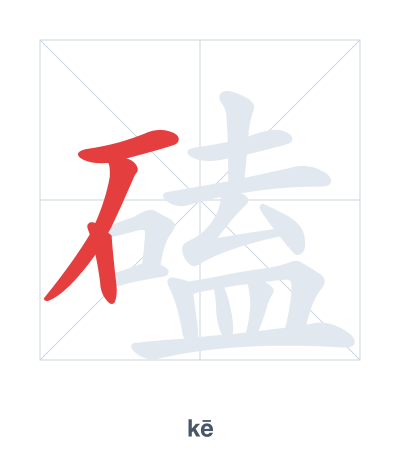
Open Hanzi Writer to see the animated stroke order and practice writing 磕 with real-time feedback.
The character 磕 (kē) is written with 15 strokes. Follow the standard Chinese stroke order: top to bottom, left to right, outside before inside. The radical 石 is one of its key components.
Practice the correct stroke order with the Hanzi Writer app to see animated stroke-by-stroke guidance with real-time feedback.
磕 means knock / bump.
As an HSK Level 7 character, 磕 is an intermediate-level character.
磕 combines the radical 石 (stone) with 盍 (hé), which provides phonetic hint. The stone radical indicates knocking against a hard surface, as in bumping or striking stone.
💡 Memory Tip: Picture a stone (石) lid (盍) being knocked off a jar with a loud 'kē' sound.
他向长辈磕头拜年。
tā xiàng zhǎng bèi kē tóu bài nián
He kowtowed to his elders to give New Year greetings.
搬家时要注意磕碰。
bān jiā shí yào zhù yì kē pèng
Be careful of bumps and scratches when moving house.
他用力磕开了一个核桃。
tā yòng lì kē kāi le yí gè hé táo
He cracked open a walnut with force.
Open Hanzi Writer to see the animated stroke order and practice writing 磕 with real-time feedback.
✨ Animated stroke order · Handwriting recognition · HSK-graded practice · Free to use
磕 is made of two parts: the left radical 石 (stone) and the right component 盍 (hé). The stone radical shows that the action involves a hard object, and 盍 suggests the sound or motion of knocking. Together they mean to knock or bump against something hard.