碇 (dìng) means "Anchor" in Chinese. It has 13 strokes with the radical 石.
Rated 4.2/5 in difficulty (advanced).
Appears in 3+ common words including 碇泊 (dìng bó), 起碇 (qǐ dìng), 碇石 (dìng shí).
Due to its 13 strokes, Hanzi Writer's error detection shows 碇 requires focused practice — most learners need 10+ attempts for consistent accuracy.
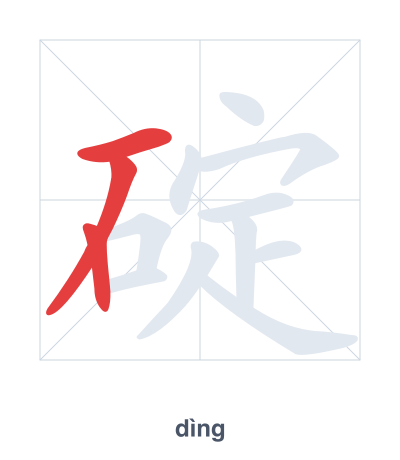
Open Hanzi Writer to see the animated stroke order and practice writing 碇 with real-time feedback.
The character 碇 (dìng) is written with 13 strokes. Follow the standard Chinese stroke order: top to bottom, left to right, outside before inside. The radical 石 is one of its key components.
Practice the correct stroke order with the Hanzi Writer app to see animated stroke-by-stroke guidance with real-time feedback.
碇 means Anchor.
碇 is a compound character combining the radical 石 (stone) with 定 (dìng, meaning 'fixed' or 'stable'). Ancient anchors were often made of stone, so the character visually represents a stone that holds a boat in place, emphasizing the idea of stability.
💡 Memory Tip: Imagine a heavy stone (石) tied to a boat to keep it fixed (定) in the water—that's an anchor.
船在海边碇泊。
chuán zài hǎi biān dìng bó
The ship is anchored by the seaside.
我们的船起碇了。
wǒ men de chuán qǐ dìng le
Our ship has weighed anchor.
这是一个大碇石。
zhè shì yí gè dà dìng shí
This is a large anchor stone.
Open Hanzi Writer to see the animated stroke order and practice writing 碇 with real-time feedback.
✨ Animated stroke order · Handwriting recognition · HSK-graded practice · Free to use
碇 combines the radical 石 (stone) on the left with 定 (fixed/stable) on the right. The stone radical suggests a heavy object used to hold a ship, while 定 emphasizes the idea of being securely fastened. Together, they create the meaning of a device that keeps a vessel stable in one place.