瞰 (kàn) means "to look down from a height; to overlook" in Chinese. It has 16 strokes with the radical 目.
Rated 4.2/5 in difficulty (advanced).
Appears in 3+ common words including 俯瞰 (fǔ kàn), 鸟瞰 (niǎo kàn), 瞰望 (kàn wàng).
Due to its 16 strokes, Hanzi Writer's error detection shows 瞰 requires focused practice — most learners need 10+ attempts for consistent accuracy.
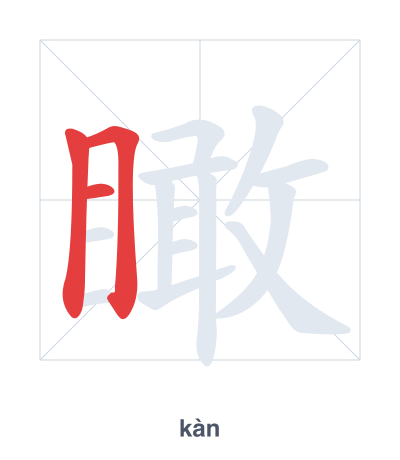
Open Hanzi Writer to see the animated stroke order and practice writing 瞰 with real-time feedback.
The character 瞰 (kàn) is written with 16 strokes. Follow the standard Chinese stroke order: top to bottom, left to right, outside before inside. The radical 目 is one of its key components.
Practice the correct stroke order with the Hanzi Writer app to see animated stroke-by-stroke guidance with real-time feedback.
瞰 means to look down from a height; to overlook.
瞰 is a phono-semantic compound with the radical 目 (eye) and the phonetic component 敢 (dare, to be bold). Together, they depict the act of boldly looking down from a height—daring to gaze upon what lies below.
💡 Memory Tip: Imagine a daring bird (敢) with a huge eye (目) swooping down to overlook the entire valley from above.
从山上俯瞰城市。
cóng shān shàng fǔ kàn chéng shì
Overlooking the city from the mountain.
飞机上可以鸟瞰大地。
fēi jī shàng kě yǐ niǎo kàn dà dì
You can get a bird's-eye view of the land from the plane.
他在窗前瞰望。
tā zài chuāng qián kàn wàng
He is looking out from the window.
Open Hanzi Writer to see the animated stroke order and practice writing 瞰 with real-time feedback.
✨ Animated stroke order · Handwriting recognition · HSK-graded practice · Free to use
瞰 is made of two parts: the left radical 目 (eye) and the right component 敢 (daring). The eye (目) shows that the meaning involves vision, and 敢 suggests boldly looking down from a height. Together, they form the idea of 'daring to look down' or 'overlook'.