睾 (gāo) means "Testicle." in Chinese. It has 14 strokes with the radical 目.
Rated 3.9/5 in difficulty (challenging).
Appears in 3+ common words including 睾丸 (gāo wán), 睾酮 (gāo tóng), 睾丸炎 (gāo wán yán).
Due to its 14 strokes, Hanzi Writer's error detection shows 睾 requires focused practice — most learners need 10+ attempts for consistent accuracy.
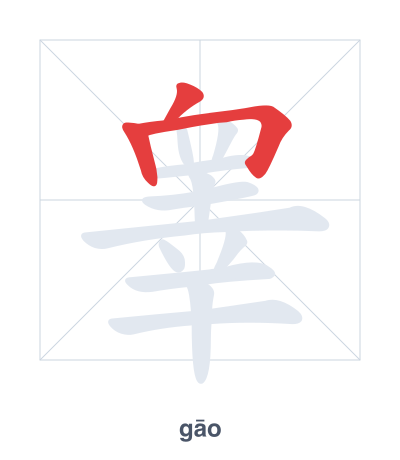
Open Hanzi Writer to see the animated stroke order and practice writing 睾 with real-time feedback.
The character 睾 (gāo) is written with 14 strokes. Follow the standard Chinese stroke order: top to bottom, left to right, outside before inside. The radical 目 is one of its key components.
Practice the correct stroke order with the Hanzi Writer app to see animated stroke-by-stroke guidance with real-time feedback.
睾 means Testicle..
The character 睾 is a compound where the top 目 (eye) visually echoes the rounded shape of a testicle, and the bottom 皋 (gāo, meaning 'high' or 'to rise') provides the phonetic element. Ancient forms were more pictographic, showing two rounded objects, which later combined with the eye-like component to emphasize the organ's shape.
💡 Memory Tip: Imagine an eye (目) balanced on a tall pedestal (皋) shaped like a testicle—you need to look up high to spot it.
医生检查了他的身体。
yī shēng jiǎn chá le tā de shēn tǐ
The doctor gave him a physical examination.
这种激素叫睾酮。
zhè zhǒng jī sù jiào gāo tóng
This hormone is called testosterone.
他患上了睾丸炎。
tā huàn shàng le gāo wán yán
He suffered from orchitis.
Open Hanzi Writer to see the animated stroke order and practice writing 睾 with real-time feedback.
✨ Animated stroke order · Handwriting recognition · HSK-graded practice · Free to use
The character 睾 is made of the radical 目 (eye) on top and the phonetic component 皋 (gāo) below. The 目 part may hint at the round shape of testicles, while 皋 gives the pronunciation gāo. Together they form a character used mainly in medical terms for male anatomy.