睽 (kuí) means "To stare." in Chinese. It has 14 strokes with the radical 目.
Rated 4.2/5 in difficulty (advanced).
Appears in 3+ common words including 众目睽睽 (zhòng mù kuí kuí), 睽违 (kuí wéi), 睽睽 (kuí kuí).
Due to its 14 strokes, Hanzi Writer's error detection shows 睽 requires focused practice — most learners need 10+ attempts for consistent accuracy.
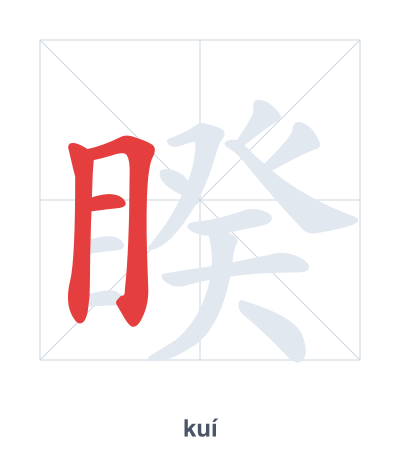
Open Hanzi Writer to see the animated stroke order and practice writing 睽 with real-time feedback.
The character 睽 (kuí) is written with 14 strokes. Follow the standard Chinese stroke order: top to bottom, left to right, outside before inside. The radical 目 is one of its key components.
Practice the correct stroke order with the Hanzi Writer app to see animated stroke-by-stroke guidance with real-time feedback.
睽 means To stare..
睽 is a compound character with the eye radical 目 and phonetic component 癸. Its original meaning in ancient texts was 'eyes not meeting' or 'looking askance,' which later developed into the sense of a fixed, intense stare—as if one's gaze is so focused it diverges from normal alignment.
💡 Memory Tip: Picture a giant eye (目) staring at the weird symbol 癸, which looks like two feet (癶) under a sky (天)—it's so bizarre you can't help but stare.
众目睽睽之下他很紧张。
zhòng mù kuí kuí zhī xià tā hěn jǐn zhāng
He was nervous under the watchful eyes of everyone.
两人睽违多年。
liǎng rén kuí wéi duō nián
The two have been separated for many years.
他睽睽注视着远方。
tā kuí kuí zhù shì zhe yuǎn fāng
He stared intently into the distance.
Open Hanzi Writer to see the animated stroke order and practice writing 睽 with real-time feedback.
✨ Animated stroke order · Handwriting recognition · HSK-graded practice · Free to use
睽 is made of the radical 目 (eye) on the left, which directly shows it is about seeing or staring. The right part 癸 (guǐ) gives the character its pronunciation and hints at the idea of separation or opposition, linking to words like 睽违 (long separation). Together, 目 + 癸 create the core meaning of a fixed, watchful stare.