欿 (kǎn) means "discontented; dissatisfied" in Chinese. It has 12 strokes with the radical 欠.
Rated 4.2/5 in difficulty (advanced).
Appears in 3+ common words including 欿然 (kǎn rán), 欿憾 (kǎn hàn), 欿欿 (kǎn kǎn).
Due to its 12 strokes, Hanzi Writer's error detection shows 欿 requires focused practice — most learners need 10+ attempts for consistent accuracy.
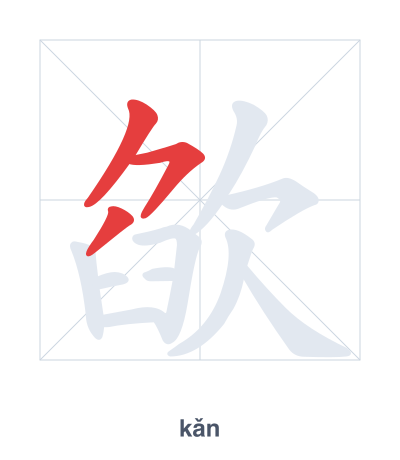
Open Hanzi Writer to see the animated stroke order and practice writing 欿 with real-time feedback.
The character 欿 (kǎn) is written with 12 strokes. Follow the standard Chinese stroke order: top to bottom, left to right, outside before inside. The radical 欠 is one of its key components.
Practice the correct stroke order with the Hanzi Writer app to see animated stroke-by-stroke guidance with real-time feedback.
欿 means discontented; dissatisfied.
| Character | 欿 |
| Pinyin | kǎn (kan) |
| Meaning | discontented; dissatisfied |
| Strokes | 12 |
| Radical | 欠 |
| Difficulty | 4.2/5 |
This compound character combines 欠 (quē, 'lack' or 'to yawn') indicating insufficiency or discontent, with 臽 (xiàn, 'pit'), which itself is formed from 人 (person) over 臼 (mortar). Together, they suggest the feeling of falling into a pit of deficiency, hence dissatisfaction.
💡 Memory Tip: Picture a discontented person (欠) who has fallen into a deep pit (臽) and is yawning with frustration because they cannot escape.
他心中感到欿然。
tā xīn zhōng gǎn dào kǎn rán
He felt dissatisfied and unfulfilled.
这种欿憾很难消除。
zhè zhǒng kǎn hàn hěn nán xiāo chú
This regret is hard to eliminate.
他的神色有些欿欿。
tā de shén sè yǒu xiē kǎn kǎn
His expression is somewhat discontented.
Open Hanzi Writer to see the animated stroke order and practice writing 欿 with real-time feedback.
✨ Animated stroke order · Handwriting recognition · HSK-graded practice · Free to use
欿 is composed of 臽 (a phonetic component) on the left and 欠 (representing a person exhaling or sighing) on the right. The 欠 radical suggests an emotional exhalation linked to feelings of discontent or dissatisfaction.