嘅 (kǎi) means "To sigh; to lament." in Chinese. It has 12 strokes with the radical 口.
Rated 4.2/5 in difficulty (advanced).
Appears in 3+ common words including 嘅叹 (kǎi tàn), 嘅然 (kǎi rán), 嘅叹不已 (kǎi tàn bù yǐ).
Due to its 12 strokes, Hanzi Writer's error detection shows 嘅 requires focused practice — most learners need 10+ attempts for consistent accuracy.
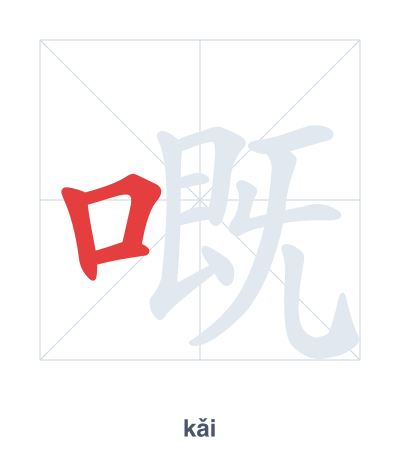
Open Hanzi Writer to see the animated stroke order and practice writing 嘅 with real-time feedback.
The character 嘅 (kǎi) is written with 12 strokes. Follow the standard Chinese stroke order: top to bottom, left to right, outside before inside. The radical 口 is one of its key components.
Practice the correct stroke order with the Hanzi Writer app to see animated stroke-by-stroke guidance with real-time feedback.
嘅 means To sigh; to lament..
嘅 is a compound character with the mouth radical (口) indicating sound or speech, and the phonetic component 既 (jì). The mouth radical suggests the action of sighing or lamenting, while 既 provides the pronunciation clue. Together, 嘅 depicts the sound of a sigh escaping from the mouth.
💡 Memory Tip: Imagine a mouth (口) letting out a heavy sigh because it's 'already' (既) too late to change the outcome.
他嘅叹了一声。
tā kǎi tàn le yī shēng
He let out a sigh.
他嘅然长叹。
tā kǎi rán cháng tàn
He sighed deeply.
令人嘅叹不已。
lìng rén kǎi tàn bù yǐ
It makes one sigh with deep emotion.
Open Hanzi Writer to see the animated stroke order and practice writing 嘅 with real-time feedback.
✨ Animated stroke order · Handwriting recognition · HSK-graded practice · Free to use
嘅 has the radical 口 (mouth) on the left, indicating an action involving the mouth. The right part is 既 (jì, meaning 'already'), which together suggests making a sound from the mouth when something is already done—hence to sigh or lament.