喀 (kā) means "(onomatopoeia) crack; cough" in Chinese. It has 12 strokes with the radical 口.
Rated 4.2/5 in difficulty (advanced).
Appears in 3+ common words including 喀嚓 (kā chā), 喀什 (kā shí), 喀斯特 (kā sī tè).
Due to its 12 strokes, Hanzi Writer's error detection shows 喀 requires focused practice — most learners need 10+ attempts for consistent accuracy.
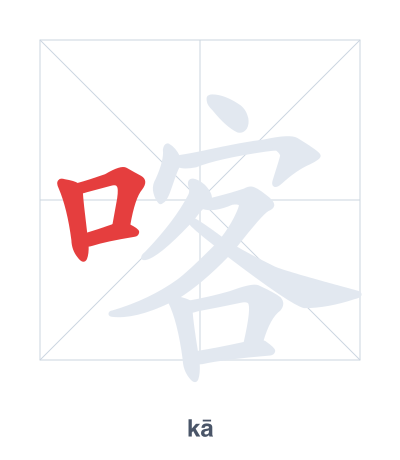
Open Hanzi Writer to see the animated stroke order and practice writing 喀 with real-time feedback.
The character 喀 (kā) is written with 12 strokes. Follow the standard Chinese stroke order: top to bottom, left to right, outside before inside. The radical 口 is one of its key components.
Practice the correct stroke order with the Hanzi Writer app to see animated stroke-by-stroke guidance with real-time feedback.
喀 means (onomatopoeia) crack; cough.
喀 combines the mouth radical (口) indicating sound or speech, with the phonetic component 客 (guest, kè) which approximates the pronunciation kā. Together they form an onomatopoeic character for a sharp, sudden sound like a cough or a crack.
💡 Memory Tip: Imagine a guest (客) suddenly coughing (口) a loud 'kā' into their hand at the dinner table.
树枝喀嚓断了。
shù zhī kā chā duàn le
The branch snapped with a crack.
喀什很美。
kā shí hěn měi
Kashgar is very beautiful.
这是喀斯特。
zhè shì kā sī tè
This is karst.
Open Hanzi Writer to see the animated stroke order and practice writing 喀 with real-time feedback.
✨ Animated stroke order · Handwriting recognition · HSK-graded practice · Free to use
喀 is made of two parts: the left radical 口 (mouth) and the right phonetic component 客. The 口 suggests the character is related to sounds from the mouth, which matches its use as an onomatopoeia for a cracking or coughing noise.