谲 (jué) means "deceitful; cunning" in Chinese. It has 14 strokes with the radical 讠.
Rated 3.9/5 in difficulty (challenging).
Appears in 3+ common words including 诡谲 (guǐ jué), 谲诈 (jué zhà), 变谲 (biàn jué).
Due to its 14 strokes, Hanzi Writer's error detection shows 谲 requires focused practice — most learners need 10+ attempts for consistent accuracy.
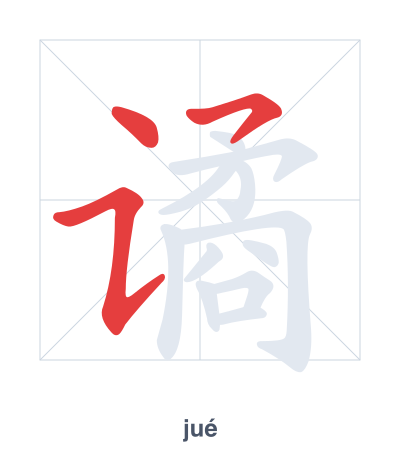
Open Hanzi Writer to see the animated stroke order and practice writing 谲 with real-time feedback.
The character 谲 (jué) is written with 14 strokes. Follow the standard Chinese stroke order: top to bottom, left to right, outside before inside. The radical 讠 is one of its key components.
Practice the correct stroke order with the Hanzi Writer app to see animated stroke-by-stroke guidance with real-time feedback.
谲 means deceitful; cunning.
谲 combines the speech radical 讠 with 矞 (yu, meaning 'cunning' or 'to pierce'), suggesting deceitful words that pierce through truth.
💡 Memory Tip: Picture a cunning speaker (讠) hiding a spear (矛) in his mouth (口) to strike with lies.
他的行为非常诡谲。
tā de xíng wéi fēi cháng guǐ jué
His behavior is very devious.
商场中充满了谲诈。
shāng chǎng zhōng chōng mǎn le jué zhà
The business world is full of trickery and deceit.
天气变谲莫测。
tiān qì biàn jué mò cè
The weather is unpredictable.
Open Hanzi Writer to see the animated stroke order and practice writing 谲 with real-time feedback.
✨ Animated stroke order · Handwriting recognition · HSK-graded practice · Free to use
The character 谲 is made of the radical 讠 (speech) on the left and the component 矞 on the right. 矞 itself carries the meaning of "cunning" or "deceive," so 谲 combines speech with deceit to mean "deceitful words."