诡 (guǐ) means "deceitful; strange" in Chinese. It has 8 strokes with the radical 讠.
Rated 3.4/5 in difficulty (challenging).
Appears in 3+ common words including 诡计 (guǐ jì), 诡异 (guǐ yì), 诡辩 (guǐ biàn).
Due to its 8 strokes, Hanzi Writer's error detection shows 诡 requires focused practice — most learners need 10+ attempts for consistent accuracy.
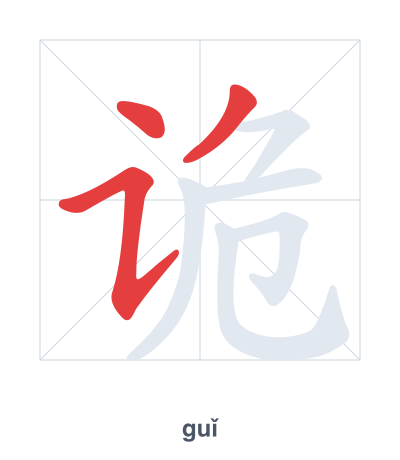
Open Hanzi Writer to see the animated stroke order and practice writing 诡 with real-time feedback.
The character 诡 (guǐ) is written with 8 strokes. Follow the standard Chinese stroke order: top to bottom, left to right, outside before inside. The radical 讠 is one of its key components.
Practice the correct stroke order with the Hanzi Writer app to see animated stroke-by-stroke guidance with real-time feedback.
诡 means deceitful; strange.
The character 诡 combines the speech radical 讠 (言) with 危 (danger). Its original meaning was 'deceitful, cunning speech'—words that are dangerous or misleading. The right side 危 itself pictures a person standing on a cliff, reinforcing the idea of precarious, treacherous talk.
💡 Memory Tip: Imagine a cunning fox (讠) balancing on a cliff (危), using tricky words to deceive hikers into taking a dangerous path.
这是他的诡计。
zhè shì tā de guǐ jì
This is his trick.
这里的气氛很诡异。
zhè lǐ de qì fēn hěn guǐ yì
The atmosphere here is very eerie.
他在故意诡辩。
tā zài gù yì guǐ biàn
He is deliberately quibbling.
Open Hanzi Writer to see the animated stroke order and practice writing 诡 with real-time feedback.
✨ Animated stroke order · Handwriting recognition · HSK-graded practice · Free to use
诡 has the speech radical 讠 on the left and the character 危 (meaning danger) on the right. Together, they suggest "dangerous speech," which leads to the meanings of deceitful or strange. This structure shows that the character is about words that are tricky or unsettling.