Hanzi Writer

How to Write 遽 (jù) — Meaning “suddenly / hurriedly”

16 strokes Radical: 辶

遽 (jù) means "suddenly / hurriedly" in Chinese. It has 16 strokes with the radical 辶.

Rated 4.2/5 in difficulty (advanced).

Appears in 3+ common words including 遽然 (jù rán), 遽变 (jù biàn), 匆遽 (cōng jù).

Due to its 16 strokes, Hanzi Writer's error detection shows 遽 requires focused practice — most learners need 10+ attempts for consistent accuracy.
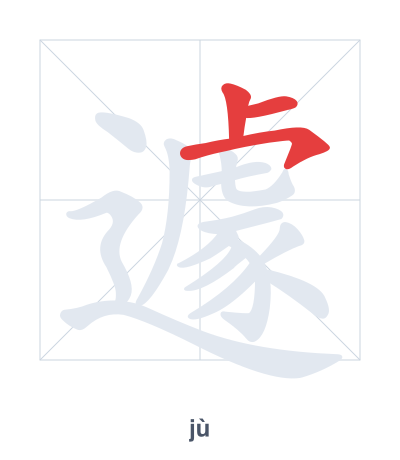
Stroke order practice for 遽 - jù

Practice Writing 遽 (jù)

Open Hanzi Writer to see the animated stroke order and practice writing 遽 with real-time feedback.

The character (jù) is written with 16 strokes. Follow the standard Chinese stroke order: top to bottom, left to right, outside before inside. The radical is one of its key components.

Practice the correct stroke order with the Hanzi Writer app to see animated stroke-by-stroke guidance with real-time feedback.

means suddenly / hurriedly.

Character
Pinyinjù (ju)
Meaningsuddenly / hurriedly
Strokes16
Radical
Difficulty4.2/5

The character 遽 is a phono-semantic compound, with 辶 (walking) indicating movement and 豦 providing the sound jù. The component 豦 originally depicted a tiger (虍) pouncing on a pig (豕), symbolizing a sudden, startled reaction. Combined, the character conveys moving hurriedly or suddenly, as if fleeing in panic.

💡 Memory Tip: Picture a pig (豕) that sees a tiger (虍) and suddenly dashes away (辶) in a great hurry.

jù rán
suddenly / abruptly
jù biàn
sudden change / abrupt transformation
cōng jù
hurried; hasty

天气遽然变冷了。

tiān qì jù rán biàn lěng le

The weather suddenly turned cold.

这里的环境发生了遽变。

zhè lǐ de huán jìng fā shēng le jù biàn

The environment here has changed suddenly.

他走得很匆遽。

tā zǒu dé hěn cōng jù

He left very hurriedly.

Character Pinyin Strokes Radical
(current) 16
zāo 14
zhē 14
lín 15
Stroke order practice for 遽 - jù

Practice Writing 遽 (jù)

Open Hanzi Writer to see the animated stroke order and practice writing 遽 with real-time feedback.

✨ Animated stroke order · Handwriting recognition · HSK-graded practice · Free to use

Frequently Asked Questions about 遽

遽 is formed by the radical 辶 (walk) on the left and the phonetic component 豦 on the right. The radical 辶 indicates movement, while 豦 originally meant "wild boar" and gives the sound jù, together suggesting a quick or sudden action, like a boar dashing away.

Characters with Radical 辶

Other 16-Stroke Characters