Hanzi Writer

How to Write 踞 (jù) — Meaning “to crouch; to sit with legs spread out”

15 strokes Radical: 足

踞 (jù) means "to crouch; to sit with legs spread out" in Chinese. It has 15 strokes with the radical 足.

Rated 4.2/5 in difficulty (advanced).

Appears in 3+ common words including 盘踞 (pán jù), 龙盘虎踞 (lóng pán hǔ jù), 踞坐 (jù zuò).

Due to its 15 strokes, Hanzi Writer's error detection shows 踞 requires focused practice — most learners need 10+ attempts for consistent accuracy.
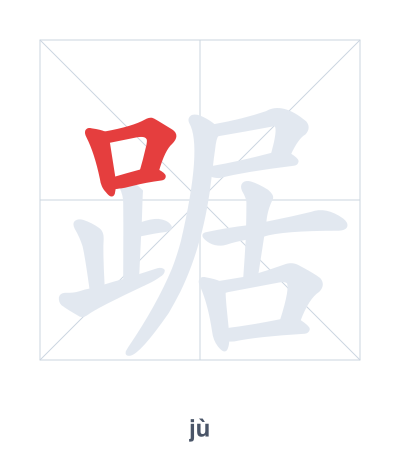
Stroke order practice for 踞 - jù

Practice Writing 踞 (jù)

Open Hanzi Writer to see the animated stroke order and practice writing 踞 with real-time feedback.

The character (jù) is written with 15 strokes. Follow the standard Chinese stroke order: top to bottom, left to right, outside before inside. The radical is one of its key components.

Practice the correct stroke order with the Hanzi Writer app to see animated stroke-by-stroke guidance with real-time feedback.

means to crouch; to sit with legs spread out.

Character
Pinyinjù (ju)
Meaningto crouch; to sit with legs spread out
Strokes15
Radical
Difficulty4.2/5

The character 踞 combines the radical 足 (foot/leg action) with 居 (jū, 'to dwell' or 'reside'). The foot radical indicates a posture or position of the legs, while 居 suggests a settled, stationary stance, together depicting a crouching or squatting position with legs spread, as if 'dwelling' low to the ground.

💡 Memory Tip: Picture a giant foot (足) squatting like a frog (居) with legs spread wide, refusing to move from its spot.

pán jù
to entrench; to occupy (a territory)
lóng pán hǔ jù
A strategic or imposing terrain (literally 'coiling dragon and crouching tiger').
jù zuò
to sit with legs spread out or crouched

敌人盘踞在山头。

dí rén pán jù zài shān tóu

The enemy is entrenched on the hilltop.

这里地形龙盘虎踞。

zhè lǐ dì xíng lóng pán hǔ jù

The terrain here is imposing and strategically strong.

他在地上踞坐着。

tā zài dì shàng jù zuò zhe

He is squatting on the ground.

Character Pinyin Strokes Radical
(current) 15
tāng 15
gēn 13
xiǎn 13
Stroke order practice for 踞 - jù

Practice Writing 踞 (jù)

Open Hanzi Writer to see the animated stroke order and practice writing 踞 with real-time feedback.

✨ Animated stroke order · Handwriting recognition · HSK-graded practice · Free to use

Frequently Asked Questions about 踞

The left side is the radical 足 (foot), which indicates actions or postures involving the legs. The right side is 居 (jū, to reside), which gives a hint to the sound and suggests staying in one place. Together, they show a posture of crouching or sitting with legs spread, staying in that position.

Characters with Radical 足

Other 15-Stroke Characters