兮 (xī) means "Classical Chinese particle (ah/oh)" in Chinese. It has 4 strokes with the radical 八.
Rated 2.4/5 in difficulty (moderate).
Appears in 3+ common words including 归去来兮 (guī qù lái xī), 巧笑倩兮 (qiǎo xiào qiàn xī), 美目盼兮 (měi mù pàn xī).
Hanzi Writer's stroke validation shows learners typically need 5-8 attempts to write 兮 with correct proportion and order.
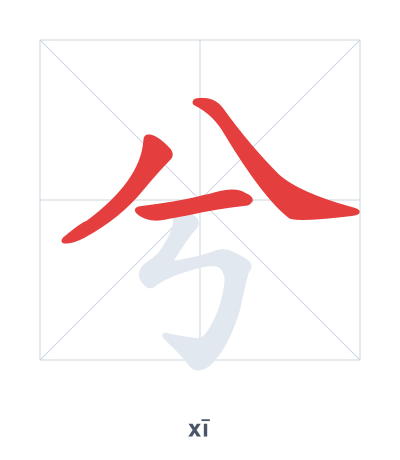
Open Hanzi Writer to see the animated stroke order and practice writing 兮 with real-time feedback.
The character 兮 (xī) is written with 4 strokes. Follow the standard Chinese stroke order: top to bottom, left to right, outside before inside. The radical 八 is one of its key components.
Practice the correct stroke order with the Hanzi Writer app to see animated stroke-by-stroke guidance with real-time feedback.
兮 means Classical Chinese particle (ah/oh).
| Character | 兮 |
| Pinyin | xī (xi) |
| Meaning | Classical Chinese particle (ah/oh) |
| Strokes | 4 |
| Radical | 八 |
| Difficulty | 2.4/5 |
In ancient scripts, 兮 depicted a person with mouth open, emitting breath or sound lines, representing an exclamatory particle like 'ah' or 'oh'. The top component 八 (originally showing open mouth or breath) and the lower hook-like stroke suggest the release of air, matching its use in classical Chinese poetry to express emotion.
💡 Memory Tip: Picture a person raising both arms (八) and a curved body (the bottom stroke) while shouting 'Xī!' in surprise, like an ancient poet sighing.
归去来兮辞很出名。
guī qù lái xī cí hěn chū míng
'Return Home' is a very famous poem.
她巧笑倩兮。
tā qiǎo xiào qiàn xī
She has a beautiful, dimpled smile.
她美目盼兮。
tā měi mù pàn xī
Her beautiful eyes are full of expression.
Open Hanzi Writer to see the animated stroke order and practice writing 兮 with real-time feedback.
✨ Animated stroke order · Handwriting recognition · HSK-graded practice · Free to use
The character 兮 is made of the radical 八 (eight) at the top and a curved hook stroke below. The top part visually suggests an open mouth or exhaling breath, while the bottom hook represents the sound continuing. Together they form a pictograph of a sigh, which matches its use as a classical exclamation like 'ah' or 'oh'.