鹫 (jiù) means "vulture or eagle" in Chinese. It has 17 strokes with the radical 鸟.
Rated 4.2/5 in difficulty (advanced).
Appears in 3+ common words including 秃鹫 (tū jiù), 雕鹫 (diāo jiù), 灵鹫山 (líng jiù shān).
Due to its 17 strokes, Hanzi Writer's error detection shows 鹫 requires focused practice — most learners need 10+ attempts for consistent accuracy.
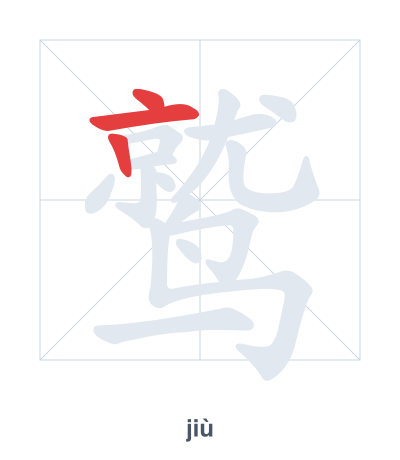
Open Hanzi Writer to see the animated stroke order and practice writing 鹫 with real-time feedback.
The character 鹫 (jiù) is written with 17 strokes. Follow the standard Chinese stroke order: top to bottom, left to right, outside before inside. The radical 鸟 is one of its key components.
Practice the correct stroke order with the Hanzi Writer app to see animated stroke-by-stroke guidance with real-time feedback.
鹫 means vulture or eagle.
鹫 is a semantic-phonetic compound: the radical 鸟 (bird) indicates it is a bird, while 就 (jiù) serves as the phonetic component giving the pronunciation. The character refers to large scavenging birds of prey like vultures and eagles.
💡 Memory Tip: Imagine a vulture perching on a sign that says 'JUST (就) a bird (鸟),' but it's actually a fearsome predator.
秃鹫飞得很高。
tū jiù fēi dé hěn gāo
Vultures fly very high.
雕鹫是凶猛的鸟。
diāo jiù shì xiōng měng de niǎo
The vulture is a fierce bird.
灵鹫山在印度。
líng jiù shān zài yìn dù
Vulture Peak is in India.
Open Hanzi Writer to see the animated stroke order and practice writing 鹫 with real-time feedback.
✨ Animated stroke order · Handwriting recognition · HSK-graded practice · Free to use
鹫 is a compound character made of two parts: the top part 就 (jiù, meaning 'then' or 'to accomplish') and the bottom part 鸟 (niǎo, 'bird'). The bird radical 鸟 shows it is a type of bird, while the upper part provides the sound and also suggests the idea of a large, powerful bird of prey, like a vulture or eagle.