鹡 (jí) means "wagtail (bird)" in Chinese. It has 15 strokes with the radical 鸟.
Rated 4.2/5 in difficulty (advanced).
Appears in 3+ common words including 鹡鸰 (jí líng), 鹡鸰鸟 (jí líng niǎo), 水鹡鸰 (shuǐ jí líng).
Due to its 15 strokes, Hanzi Writer's error detection shows 鹡 requires focused practice — most learners need 10+ attempts for consistent accuracy.
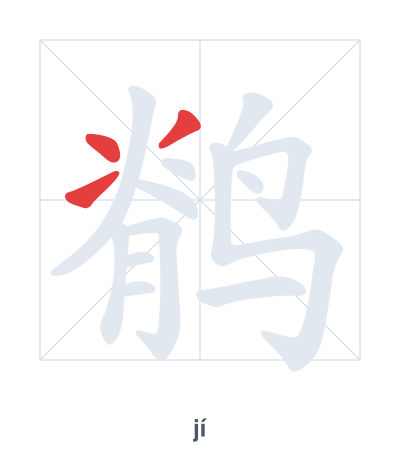
Open Hanzi Writer to see the animated stroke order and practice writing 鹡 with real-time feedback.
The character 鹡 (jí) is written with 15 strokes. Follow the standard Chinese stroke order: top to bottom, left to right, outside before inside. The radical 鸟 is one of its key components.
Practice the correct stroke order with the Hanzi Writer app to see animated stroke-by-stroke guidance with real-time feedback.
鹡 means wagtail (bird).
鹡 is a phono-semantic compound. The right side 鸟 (bird) indicates it's a type of bird, while the left side 脊 (jí, meaning 'spine' or 'ridge') provides the pronunciation and hints at the wagtail's distinctive habit of bobbing its tail up and down like a moving spine.
💡 Memory Tip: Imagine a bird (鸟) with a ridged spine (脊) that constantly wags its tail back and forth, like a tiny feathered gymnast doing spinal twists.
鹡鸰在草地上跳。
jí líng zài cǎo dì shàng tiào
The wagtail is hopping on the grass.
鹡鸰鸟的尾巴很长。
jí líng niǎo de wěi ba hěn zhǎng
The wagtail has a very long tail.
水鹡鸰在河边飞。
shuǐ jí líng zài hé biān fēi
The water wagtail is flying by the river.
Open Hanzi Writer to see the animated stroke order and practice writing 鹡 with real-time feedback.
✨ Animated stroke order · Handwriting recognition · HSK-graded practice · Free to use
鹡 is a left-right character. The left part is 脊 (jǐ, spine) which gives the pronunciation, and the right part is 鸟 (bird) which shows the meaning. Together, they form a type of bird called a wagtail.