喼 (jiē) means "suitcase, trunk (Cantonese)" in Chinese. It has 12 strokes with the radical 口.
Rated 4.2/5 in difficulty (advanced).
Appears in 3+ common words including 喼汁 (jiē zhī), 喼帽 (jiē mào), 喼里 (jiē lǐ).
Due to its 12 strokes, Hanzi Writer's error detection shows 喼 requires focused practice — most learners need 10+ attempts for consistent accuracy.
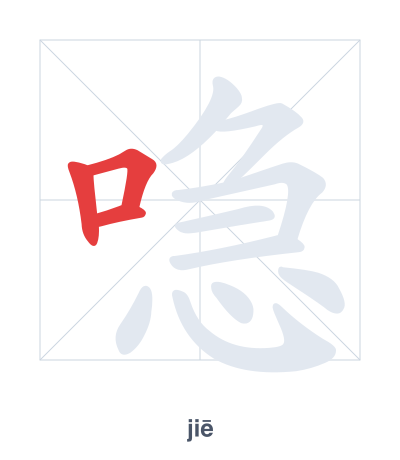
Open Hanzi Writer to see the animated stroke order and practice writing 喼 with real-time feedback.
The character 喼 (jiē) is written with 12 strokes. Follow the standard Chinese stroke order: top to bottom, left to right, outside before inside. The radical 口 is one of its key components.
Practice the correct stroke order with the Hanzi Writer app to see animated stroke-by-stroke guidance with real-time feedback.
喼 means suitcase, trunk (Cantonese).
喼 is a Cantonese-specific character combining the radical 口 (mouth, enclosure) as a semantic hint for a container or opening, with 急 (urgent) as a phonetic component. The character likely originated as a loanword for 'suitcase' or 'trunk,' with the enclosure shape suggesting a box-like container.
💡 Memory Tip: Picture a suitcase with a wide-open mouth (口) that you rush to pack because you're in a hurry (急).
我喜欢蘸喼汁吃点心。
wǒ xǐ huān zhàn jiē zhī chī diǎn xīn
I like dipping dim sum in Worcestershire sauce.
他戴着一顶喼帽。
tā dài zhe yī dǐng jiē mào
He is wearing a peaked cap.
这件衣服是喼里做的。
zhè jiàn yī fú shì jiē lǐ zuò de
This garment is made of gabardine.
Open Hanzi Writer to see the animated stroke order and practice writing 喼 with real-time feedback.
✨ Animated stroke order · Handwriting recognition · HSK-graded practice · Free to use
The character 喼 has two parts: the left radical 口 (mouth) and the right part 急 (urgent). The 口 radical suggests a container or opening, like a suitcase, while 急 provides the Cantonese pronunciation (gip1). This combination is typical for characters created to transliterate foreign words.