挢 (jiǎo) means "correct; lift" in Chinese. It has 9 strokes with the radical 扌.
Rated 4/5 in difficulty (challenging).
Appears in 3+ common words including 挢舌 (jiǎo shé), 挢首 (jiǎo shǒu), 挢然 (jiǎo rán).
Due to its 9 strokes, Hanzi Writer's error detection shows 挢 requires focused practice — most learners need 10+ attempts for consistent accuracy.
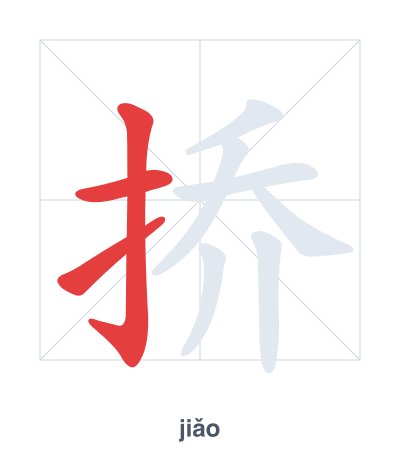
Open Hanzi Writer to see the animated stroke order and practice writing 挢 with real-time feedback.
The character 挢 (jiǎo) is written with 9 strokes. Follow the standard Chinese stroke order: top to bottom, left to right, outside before inside. The radical 扌 is one of its key components.
Practice the correct stroke order with the Hanzi Writer app to see animated stroke-by-stroke guidance with real-time feedback.
挢 means correct; lift.
挢 is a compound of the hand radical 扌 (hand) and 乔 (tall, lift). The hand indicates an action, and 乔 suggests raising or straightening something, so together they mean 'to lift' or 'to correct' something by hand.
💡 Memory Tip: Imagine using your hand (扌) to lift a tall (乔) crooked pole and straighten it—that's how you correct it.
他惊讶得挢舌。
tā jīng yà dé jiǎo shé
He was so surprised that he was speechless.
他挢首远望。
tā jiǎo shǒu yuǎn wàng
He raised his head and looked into the distance.
他挢然独立。
tā jiǎo rán dú lì
He stood tall and independent.
Open Hanzi Writer to see the animated stroke order and practice writing 挢 with real-time feedback.
✨ Animated stroke order · Handwriting recognition · HSK-graded practice · Free to use
挢 is composed of the hand radical 扌 on the left and the phonetic component 乔 on the right. The hand radical suggests an action done with the hand, such as lifting, while 乔 originally means "tall" or "high," so together they imply raising something up or correcting its position.