鉴 (jiàn) means "To examine / mirror / reflect" in Chinese. It has 13 strokes with the radical 金, and is HSK Level 6.
Rated 4.2/5 in difficulty (advanced).
Harder than 96% of HSK Level 6 characters.
Appears in 3+ common words including 鉴定 (jiàn dìng), 借鉴 (jiè jiàn), 鉴赏 (jiàn shǎng).
Due to its 13 strokes, Hanzi Writer's error detection shows 鉴 requires focused practice — most learners need 10+ attempts for consistent accuracy.
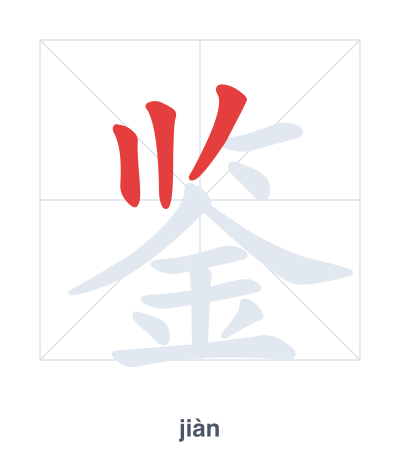
Open Hanzi Writer to see the animated stroke order and practice writing 鉴 with real-time feedback.
The character 鉴 (jiàn) is written with 13 strokes. Follow the standard Chinese stroke order: top to bottom, left to right, outside before inside. The radical 金 is one of its key components.
Practice the correct stroke order with the Hanzi Writer app to see animated stroke-by-stroke guidance with real-time feedback.
鉴 means To examine / mirror / reflect.
As an HSK Level 6 character, 鉴 is an intermediate-level character.
鉴 originally depicted a bronze mirror, combining 金 (metal) for the material and 監 (to supervise), which shows a person kneeling over a basin to look at their reflection. The character thus visually represents the act of examining oneself in a mirror.
💡 Memory Tip: Picture a metal basin (金) with a person leaning over it (like the right side 监) to inspect their own reflection.
专家在鉴定古董。
zhuān jiā zài jiàn dìng gǔ dǒng
Experts are appraising antiques.
我们可以借鉴经验。
wǒ men kě yǐ jiè jiàn jīng yàn
We can learn from experience.
他喜欢鉴赏画作。
tā xǐ huān jiàn shǎng huà zuò
He likes appreciating paintings.
Open Hanzi Writer to see the animated stroke order and practice writing 鉴 with real-time feedback.
✨ Animated stroke order · Handwriting recognition · HSK-graded practice · Free to use
鉴 is formed with the radical 金 (metal) above and the phonetic component 监 (jiān, to supervise) below. This structure reflects that ancient mirrors were made of bronze (metal) and used for inspecting one's reflection, linking the ideas of metal and supervision.