Hanzi Writer

How to Write 釜 (fǔ) — Meaning “Cauldron or pot”

10 strokes Radical: 金

釜 (fǔ) means "Cauldron or pot" in Chinese. It has 10 strokes with the radical 金.

Rated 4.2/5 in difficulty (advanced).

Appears in 3+ common words including 釜底抽薪 (fǔ dǐ chōu xīn), 破釜沉舟 (pò fǔ chén zhōu), 锅釜 (guō fǔ).

Due to its 10 strokes, Hanzi Writer's error detection shows 釜 requires focused practice — most learners need 10+ attempts for consistent accuracy.
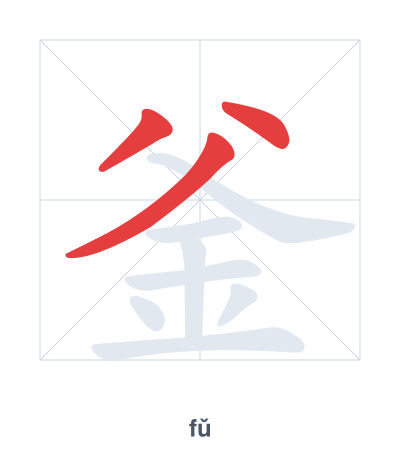
Stroke order practice for 釜 - fǔ

Practice Writing 釜 (fǔ)

Open Hanzi Writer to see the animated stroke order and practice writing 釜 with real-time feedback.

The character (fǔ) is written with 10 strokes. Follow the standard Chinese stroke order: top to bottom, left to right, outside before inside. The radical is one of its key components.

Practice the correct stroke order with the Hanzi Writer app to see animated stroke-by-stroke guidance with real-time feedback.

means Cauldron or pot.

Character
Pinyinfǔ (fu)
MeaningCauldron or pot
Strokes10
Radical
Difficulty4.2/5

釜 is a compound character: the top component 父 (fǔ, meaning 'father') provides the sound, while the bottom radical 金 ('metal') indicates the material, forming a 'metal pot' or cauldron. Its ancient form depicted a bronze cooking vessel with handles and a wide mouth.

💡 Memory Tip: Imagine your father (父) lifting a heavy metal (金) cauldron full of soup.

fǔ dǐ chōu xīn
To take a drastic measure to solve a problem at its source
pò fǔ chén zhōu
to burn one's boats / determined
guō fǔ
Pots and pans; cooking vessels

这是一个釜底抽薪的办法。

zhè shì yí gè fǔ dǐ chōu xīn de bàn fǎ

This is a solution that strikes at the root of the problem.

我们要破釜沉舟去努力。

wǒ men yào pò fǔ chén zhōu qù nǔ lì

We must give it our all with no turning back.

古代人用锅釜煮饭。

gǔ dài rén yòng guō fǔ zhǔ fàn

Ancient people used pots and cauldrons to cook rice.

Character Pinyin Strokes Radical
(current) 10
jīn 8
duó 12
Stroke order practice for 釜 - fǔ

Practice Writing 釜 (fǔ)

Open Hanzi Writer to see the animated stroke order and practice writing 釜 with real-time feedback.

✨ Animated stroke order · Handwriting recognition · HSK-graded practice · Free to use

Frequently Asked Questions about 釜

釜 is composed of two parts: the top part 父 (fù, meaning 'father') and the bottom part 金 (jīn, meaning 'gold' or 'metal'). Together, 父 acts as a phonetic component suggesting the pronunciation, while 金 indicates that the character refers to a metal object, specifically a cauldron or pot.

Characters with Radical 金

Other 10-Stroke Characters