腱 (jiàn) means "tendon" in Chinese. It has 12 strokes with the radical 月.
Rated 4.2/5 in difficulty (advanced).
Appears in 3+ common words including 肌腱 (jī jiàn), 牛腱子 (niú jiàn zi), 跟腱 (gēn jiàn).
Due to its 12 strokes, Hanzi Writer's error detection shows 腱 requires focused practice — most learners need 10+ attempts for consistent accuracy.
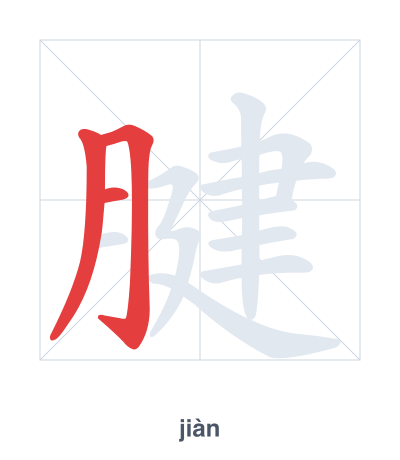
Open Hanzi Writer to see the animated stroke order and practice writing 腱 with real-time feedback.
The character 腱 (jiàn) is written with 12 strokes. Follow the standard Chinese stroke order: top to bottom, left to right, outside before inside. The radical 月 is one of its key components.
Practice the correct stroke order with the Hanzi Writer app to see animated stroke-by-stroke guidance with real-time feedback.
腱 means tendon.
腱 is a phono-semantic compound: the radical 月 (flesh/body part) indicates it relates to the body, while 建 (jiàn, to build) provides the pronunciation and hints at tendons as the 'building' fibers that connect muscle to bone and support movement.
💡 Memory Tip: Imagine a builder (建) using a strong tendon as a rope to lift a heavy moon (月) — the tendon is the tough cord that holds everything together.
他的肌腱受伤了。
tā de jī jiàn shòu shāng le
His tendon is injured.
我买了牛腱子肉。
wǒ mǎi le niú jiàn zi ròu
I bought beef shank.
运动员跟腱断了。
yùn dòng yuán gēn jiàn duàn le
The athlete's Achilles tendon is ruptured.
Open Hanzi Writer to see the animated stroke order and practice writing 腱 with real-time feedback.
✨ Animated stroke order · Handwriting recognition · HSK-graded practice · Free to use
The left side 月 (肉) is the radical for meat or body parts, indicating 腱 relates to the body. The right side 建 (jiàn) contributes the pronunciation and suggests the idea of building or firmness, as tendons are strong connective tissues.