谫 (jiǎn) means "shallow; superficial" in Chinese. It has 13 strokes with the radical 讠.
Rated 3.9/5 in difficulty (challenging).
Appears in 3+ common words including 谫陋 (jiǎn lòu), 才谫 (cái jiǎn), 浅谫 (qiǎn jiǎn).
Due to its 13 strokes, Hanzi Writer's error detection shows 谫 requires focused practice — most learners need 10+ attempts for consistent accuracy.
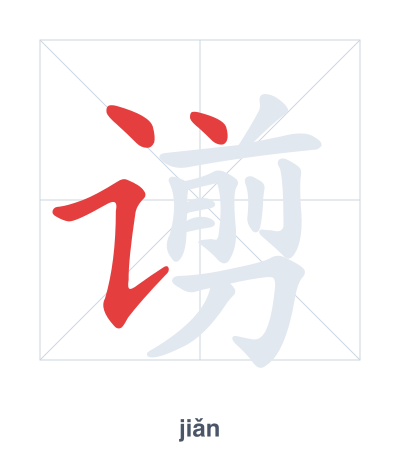
Open Hanzi Writer to see the animated stroke order and practice writing 谫 with real-time feedback.
The character 谫 (jiǎn) is written with 13 strokes. Follow the standard Chinese stroke order: top to bottom, left to right, outside before inside. The radical 讠 is one of its key components.
Practice the correct stroke order with the Hanzi Writer app to see animated stroke-by-stroke guidance with real-time feedback.
谫 means shallow; superficial.
谫 combines the radical 讠 (speech) with 翦 (to cut), which also gives the sound. The idea is that speech that has been "cut short" or limited in depth becomes shallow or superficial.
💡 Memory Tip: Imagine a pair of scissors (翦) snipping off all deep thoughts from a speech bubble (讠), leaving only a shallow, surface-level remark.
我的见识谫陋。
wǒ de jiàn shí jiǎn lòu
My knowledge is limited and shallow.
他自谦才谫。
tā zì qiān cái jiǎn
He modestly said his talent was limited.
这种学问很浅谫。
zhè zhǒng xué wèn hěn qiǎn jiǎn
This knowledge is very shallow and superficial.
Open Hanzi Writer to see the animated stroke order and practice writing 谫 with real-time feedback.
✨ Animated stroke order · Handwriting recognition · HSK-graded practice · Free to use
谫 is composed of the radical 讠 (speech) on the left and the component 翦 on the right. 翦 means "to cut" or "scissors," suggesting that the speech is "cut short" or lacking depth, which matches the character's meaning of shallow or superficial. This structure visually links limited expression to shallowness.