猳 (jiā) means "male pig or boar" in Chinese. It has 12 strokes with the radical 犭.
Rated 4.2/5 in difficulty (advanced).
Appears in 3+ common words including 猳豚 (jiā tún), 猳玃 (jiā jué), 牡猳 (mǔ jiā).
Due to its 12 strokes, Hanzi Writer's error detection shows 猳 requires focused practice — most learners need 10+ attempts for consistent accuracy.
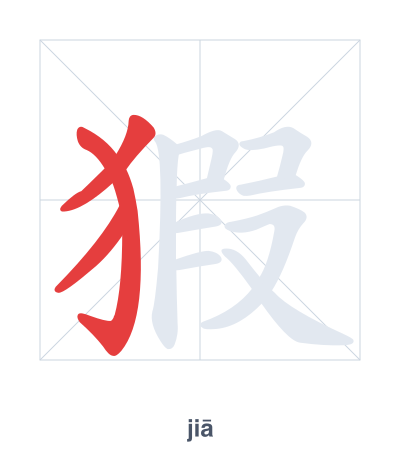
Open Hanzi Writer to see the animated stroke order and practice writing 猳 with real-time feedback.
The character 猳 (jiā) is written with 12 strokes. Follow the standard Chinese stroke order: top to bottom, left to right, outside before inside. The radical 犭 is one of its key components.
Practice the correct stroke order with the Hanzi Writer app to see animated stroke-by-stroke guidance with real-time feedback.
猳 means male pig or boar.
猳 is a phono-semantic compound: the radical 犭 (animal) signifies a beast, while the component 叚 (jiǎ) provides the pronunciation. The character specifically refers to a male pig or wild boar, emphasizing its animal nature.
💡 Memory Tip: Picture a male boar with a fake mustache (叚) glued on its snout, strutting like a tough guy.
猳豚是一种动物。
jiā tún shì yī zhǒng dòng wù
A piglet is a type of animal.
猳玃在树上跳。
jiā jué zài shù shàng tiào
The large ape is jumping in the trees.
牡猳在草地上跑。
mǔ jiā zài cǎo dì shàng pǎo
The boar is running on the grass.
Open Hanzi Writer to see the animated stroke order and practice writing 猳 with real-time feedback.
✨ Animated stroke order · Handwriting recognition · HSK-graded practice · Free to use
The character 猳 is made of the radical 犭 (dog/animal) on the left and 叚 on the right. The radical 犭 shows it is an animal, while 叚 (jiǎ, meaning 'false' or 'borrow') hints at a large, strong animal like a boar. Together, they form the meaning 'male pig' or 'boar,' though the exact etymology is unclear.