玃 (jué) means "Large ape (ancient term)" in Chinese. It has 23 strokes with the radical 犭.
Rated 3.8/5 in difficulty (challenging).
Appears in 3+ common words including 玃猿 (jué yuán), 玃踢 (jué tī), 玃子 (jué zi).
Due to its 23 strokes, Hanzi Writer's error detection shows 玃 requires focused practice — most learners need 10+ attempts for consistent accuracy.
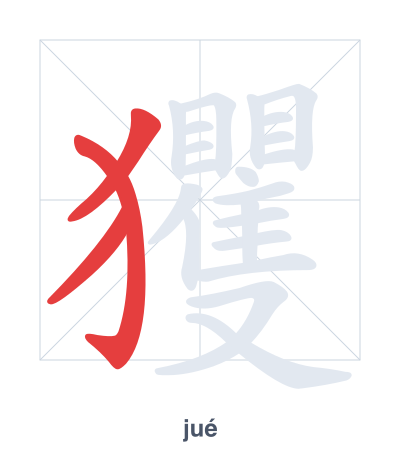
Open Hanzi Writer to see the animated stroke order and practice writing 玃 with real-time feedback.
The character 玃 (jué) is written with 23 strokes. Follow the standard Chinese stroke order: top to bottom, left to right, outside before inside. The radical 犭 is one of its key components.
Practice the correct stroke order with the Hanzi Writer app to see animated stroke-by-stroke guidance with real-time feedback.
玃 means Large ape (ancient term).
玃 is a phono-semantic compound: the radical 犭 (dog/animal) indicates it is a beast, while 矍 (jué, 'a startled look') provides the pronunciation and hints at the creature's large, wide-eyed, or fierce appearance. In ancient texts, 玃 referred to a legendary giant ape known for its strength and cunning.
💡 Memory Tip: Picture a giant ape (犭) with huge, startled eyes (矍) peering out from the jungle, ready to grab you.
玃猿是一种大猴子。
jué yuán shì yī zhǒng dà hóu zi
The Jueyuan is a type of large monkey.
这种动作叫作玃踢。
zhè zhǒng dòng zuò jiào zuò jué tī
This movement is called a leap.
玃子在树上跳。
jué zi zài shù shàng tiào
The large ape is jumping in the tree.
Open Hanzi Writer to see the animated stroke order and practice writing 玃 with real-time feedback.
✨ Animated stroke order · Handwriting recognition · HSK-graded practice · Free to use
The character 玃 combines the radical 犭 (dog/beast) on the left, indicating it is an animal, with the right part 矍 (jué, meaning "to look around in surprise"). The right side hints at the large ape's alert and active nature, together forming the idea of a large ancient ape.