鹉 (wǔ) means "Parrot" in Chinese. It has 13 strokes with the radical 鸟.
Rated 4.2/5 in difficulty (advanced).
Appears in 3+ common words including 鹦鹉 (yīng wǔ), 小鹦鹉 (xiǎo yīng wǔ), 鹦鹉学舌 (yīng wǔ xué shé).
Due to its 13 strokes, Hanzi Writer's error detection shows 鹉 requires focused practice — most learners need 10+ attempts for consistent accuracy.
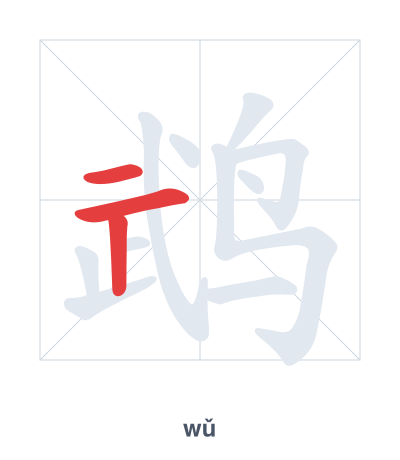
Open Hanzi Writer to see the animated stroke order and practice writing 鹉 with real-time feedback.
The character 鹉 (wǔ) is written with 13 strokes. Follow the standard Chinese stroke order: top to bottom, left to right, outside before inside. The radical 鸟 is one of its key components.
Practice the correct stroke order with the Hanzi Writer app to see animated stroke-by-stroke guidance with real-time feedback.
鹉 means Parrot.
鹉 is a compound character combining the phonetic component 武 (wǔ, meaning 'martial') and the semantic radical 鸟 (niǎo, 'bird'). The 武 hints at the pronunciation, while 鸟 indicates that the character refers to a type of bird—specifically, it is used in 鹦鹉 (yīngwǔ), meaning 'parrot'.
💡 Memory Tip: Imagine a parrot doing kung fu moves (武) while perched on a branch, showing off its martial bird skills.
这只鹦鹉会说话。
zhè zhǐ yīng wǔ huì shuō huà
This parrot can talk.
我家有一只小鹦鹉。
wǒ jiā yǒu yī zhī xiǎo yīng wǔ
My family has a small parrot.
他只是在鹦鹉学舌。
tā zhǐ shì zài yīng wǔ xué shé
He is just parroting what others say.
Open Hanzi Writer to see the animated stroke order and practice writing 鹉 with real-time feedback.
✨ Animated stroke order · Handwriting recognition · HSK-graded practice · Free to use
The character 鹉 is a left-right structure. The left part is the radical 鸟 (bird), which gives the meaning clue. The right part 武 (military) provides the pronunciation wǔ, but does not relate to the meaning of parrot.