墼 (jī) means "adobe brick" in Chinese. It has 16 strokes with the radical 土.
Rated 4.2/5 in difficulty (advanced).
Appears in 3+ common words including 土墼 (tǔ jī), 墼块 (jī kuài), 墼墙 (jī qiáng).
Due to its 16 strokes, Hanzi Writer's error detection shows 墼 requires focused practice — most learners need 10+ attempts for consistent accuracy.
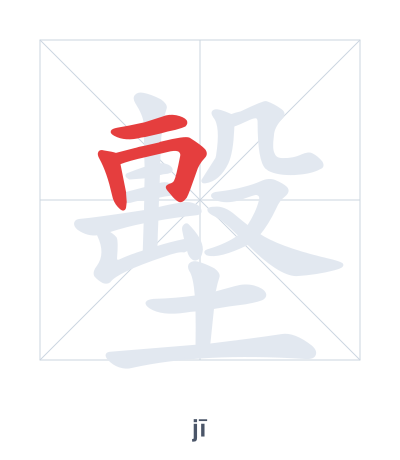
Open Hanzi Writer to see the animated stroke order and practice writing 墼 with real-time feedback.
The character 墼 (jī) is written with 16 strokes. Follow the standard Chinese stroke order: top to bottom, left to right, outside before inside. The radical 土 is one of its key components.
Practice the correct stroke order with the Hanzi Writer app to see animated stroke-by-stroke guidance with real-time feedback.
墼 means adobe brick.
墼 combines the radical 土 (earth/clay) as the material, and 殸 (jī) as a phonetic component. It refers to an unfired brick, made by pressing clay into a mold and drying it in the sun.
💡 Memory Tip: Imagine a square adobe brick (土) that, when tapped, makes a hollow 'jī' sound like a broken stone chime (殸).
这种房子是用土墼盖的。
zhè zhǒng fáng zi shì yòng tǔ jī gài de
This house is built with sun-dried mud bricks.
地上有很多墼块。
dì shàng yǒu hěn duō jī kuài
There are many sun-dried bricks on the ground.
墼墙非常厚。
jī qiáng fēi cháng hòu
The adobe wall is very thick.
Open Hanzi Writer to see the animated stroke order and practice writing 墼 with real-time feedback.
✨ Animated stroke order · Handwriting recognition · HSK-graded practice · Free to use
墼 combines the radical 土 (earth) at the bottom with the phonetic component 既 (jì) on top. The earth radical shows the material (dirt or clay), while 既 gives a clue to the pronunciation jī. Together they represent a brick made from earth.