恚 (huì) means "anger" in Chinese. It has 10 strokes with the radical 心.
Rated 4.2/5 in difficulty (advanced).
Appears in 3+ common words including 嗔恚 (chēn huì), 恚恨 (huì hèn), 恚怒 (huì nù).
Due to its 10 strokes, Hanzi Writer's error detection shows 恚 requires focused practice — most learners need 10+ attempts for consistent accuracy.
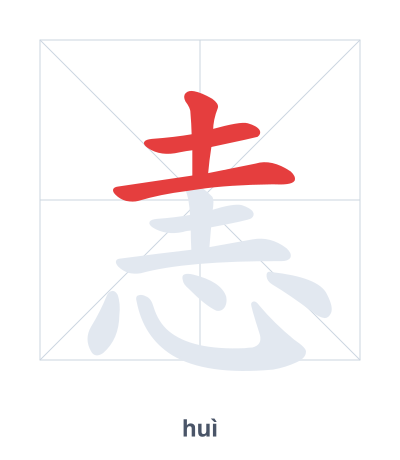
Open Hanzi Writer to see the animated stroke order and practice writing 恚 with real-time feedback.
The character 恚 (huì) is written with 10 strokes. Follow the standard Chinese stroke order: top to bottom, left to right, outside before inside. The radical 心 is one of its key components.
Practice the correct stroke order with the Hanzi Writer app to see animated stroke-by-stroke guidance with real-time feedback.
恚 means anger.
恚 is a compound character combining 圭 (guī, a jade tablet, used here as a phonetic component) and 心 (heart, the radical indicating emotion). The heart radical signals that this character relates to an internal feeling, specifically anger or resentment. Thus, the character's visual structure places the phonetic element 圭 above the semantic 'heart' to represent the concept of anger brewing inside.
💡 Memory Tip: Picture two heavy piles of earth (圭) pressing down on your heart (心), making you fume with suppressed anger.
他心中充满嗔恚。
tā xīn zhōng chōng mǎn chēn huì
His heart was full of anger and resentment.
别再心存恚恨。
bié zài xīn cún huì hèn
Stop harboring bitterness.
他满脸恚怒之色。
tā mǎn liǎn huì nù zhī sè
His face was full of anger.
Open Hanzi Writer to see the animated stroke order and practice writing 恚 with real-time feedback.
✨ Animated stroke order · Handwriting recognition · HSK-graded practice · Free to use
恚 is made of two parts: 圭 (a jade tablet) on top and 心 (heart/mind) below. The heart component directly connects to emotion, and the upper part suggests something pressing or piercing, so together they imply anger rising from the heart like a sharp object.