哕 (huì/yuě) means "To retch / To vomit" in Chinese. It has 9 strokes with the radical 口.
Rated 4/5 in difficulty (challenging).
Appears in 3+ common words including 呕哕 (ǒu huì), 干哕 (gān yuě), 哕了 (huì le).
Due to its 9 strokes, Hanzi Writer's error detection shows 哕 requires focused practice — most learners need 10+ attempts for consistent accuracy.
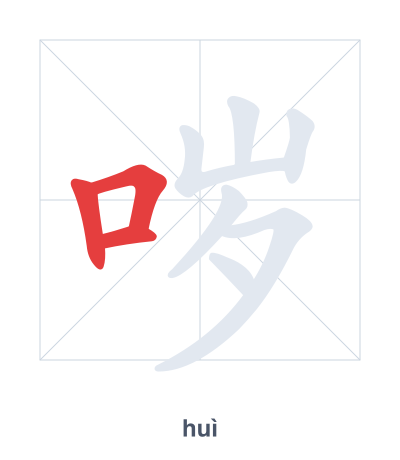
Open Hanzi Writer to see the animated stroke order and practice writing 哕 with real-time feedback.
The character 哕 (huì/yuě) is written with 9 strokes. Follow the standard Chinese stroke order: top to bottom, left to right, outside before inside. The radical 口 is one of its key components.
Practice the correct stroke order with the Hanzi Writer app to see animated stroke-by-stroke guidance with real-time feedback.
哕 means To retch / To vomit.
This is a polyphonic character with readings: huì, yuě.
The character 哕 combines the mouth radical 口 with 岁 (suì, 'year') as a phonetic component, originally describing the sound of retching or vomiting from the mouth. In ancient texts, it depicted the audible spasm of nausea, with 岁 contributing pronunciation rather than meaning.
💡 Memory Tip: Picture a mouth (口) spewing out a whole year's worth (岁) of spoiled food—a violent retch that sounds like 'huì!'
他感到恶心想呕哕。
tā gǎn dào ě xīn xiǎng ǒu huì
He feels nauseous and wants to vomit.
他难受得一直干哕。
tā nán shòu dé yì zhí gān yuě
He was so uncomfortable that he kept retching.
小猫刚才哕了。
xiǎo māo gāng cái huì le
The kitten just retched.
Open Hanzi Writer to see the animated stroke order and practice writing 哕 with real-time feedback.
✨ Animated stroke order · Handwriting recognition · HSK-graded practice · Free to use
哕 is made of the radical 口 (mouth) on the left and the phonetic component 岁 (suì, year) on the right. The mouth radical suggests the action happens through the mouth, like retching. The phonetic part gives a rough pronunciation hint, but the meaning comes from the context of mouth movements for vomiting.