隳 (huī) means "to destroy; to demolish" in Chinese. It has 17 strokes with the radical 阝.
Rated 3.9/5 in difficulty (challenging).
Appears in 3+ common words including 隳坏 (huī huài), 隳废 (huī fèi), 隳突 (huī tū).
Due to its 17 strokes, Hanzi Writer's error detection shows 隳 requires focused practice — most learners need 10+ attempts for consistent accuracy.
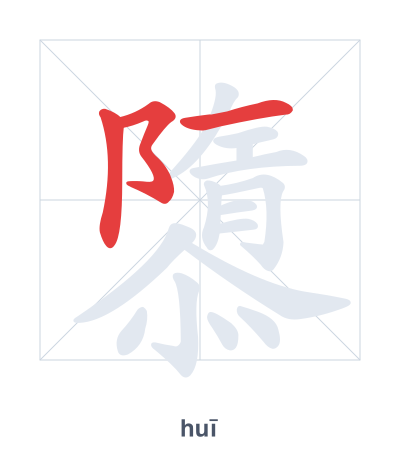
Open Hanzi Writer to see the animated stroke order and practice writing 隳 with real-time feedback.
The character 隳 (huī) is written with 17 strokes. Follow the standard Chinese stroke order: top to bottom, left to right, outside before inside. The radical 阝 is one of its key components.
Practice the correct stroke order with the Hanzi Writer app to see animated stroke-by-stroke guidance with real-time feedback.
隳 means to destroy; to demolish.
隳 is a variant of 毁 (huǐ, 'to destroy') with the radical 阝 (a mound or hill) added to emphasize the destruction of a physical structure. The left side represents a mound, while the right side borrows the sound and meaning of 毁, together conveying the idea of demolishing a hill or building.
💡 Memory Tip: Imagine a hill (阝) being flattened by a giant wrecking ball whose chain forms the complex right side of 隳, smashing it to rubble.
老城墙已经隳坏。
lǎo chéng qiáng yǐ jīng huī huài
The old city wall has fallen into ruin.
不要隳废了学业。
bú yào huī fèi le xué yè
Don't neglect your studies.
隳突了这里的安静。
huī tū le zhè lǐ de ān jìng
Disturbed the peace and quiet of this place.
Open Hanzi Writer to see the animated stroke order and practice writing 隳 with real-time feedback.
✨ Animated stroke order · Handwriting recognition · HSK-graded practice · Free to use
The character 隳 is made of the radical 阝 (meaning "mound" or "hill") on the left, and a complex right part that suggests breaking apart. This structure visually implies a hill collapsing or being destroyed, which matches its meaning "to destroy" or "to demolish."