簧 (huáng) means "reed (of a musical instrument) / spring" in Chinese. It has 17 strokes with the radical 竹.
Rated 4.2/5 in difficulty (advanced).
Appears in 3+ common words including 弹簧 (tán huáng), 簧片 (huáng piàn), 锁簧 (suǒ huáng).
Due to its 17 strokes, Hanzi Writer's error detection shows 簧 requires focused practice — most learners need 10+ attempts for consistent accuracy.
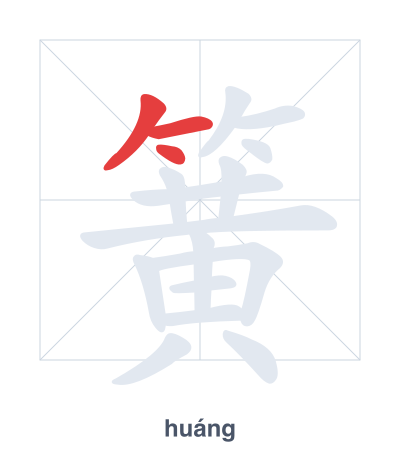
Open Hanzi Writer to see the animated stroke order and practice writing 簧 with real-time feedback.
The character 簧 (huáng) is written with 17 strokes. Follow the standard Chinese stroke order: top to bottom, left to right, outside before inside. The radical 竹 is one of its key components.
Practice the correct stroke order with the Hanzi Writer app to see animated stroke-by-stroke guidance with real-time feedback.
簧 means reed (of a musical instrument) / spring.
簧 is a phono-semantic compound: the bamboo radical (竹) signifies the material of the reed or spring, and 黃 (huáng) provides the pronunciation. Originally it referred to the reed of a musical instrument, which was made from bamboo, but also extended to mean a mechanical spring.
💡 Memory Tip: Picture a yellow (黃) bamboo (竹) reed that springs back like a musical tongue when you blow on it.
这个沙发里的弹簧坏了。
zhè ge shā fā lǐ de tán huáng huài le
The springs in this sofa are broken.
乐器的簧片需要更换。
yuè qì de huáng piàn xū yào gēng huàn
The reed of the musical instrument needs to be replaced.
门上的锁簧生锈了。
mén shàng de suǒ huáng shēng xiù le
The spring in the door lock is rusty.
Open Hanzi Writer to see the animated stroke order and practice writing 簧 with real-time feedback.
✨ Animated stroke order · Handwriting recognition · HSK-graded practice · Free to use
簧 is composed of 竹 (bamboo, used for musical instruments) on top and 黄 (yellow) below. Together, bamboo and yellow represent the reed of a wind instrument, which is often made from bamboo and can have a yellowish color. The character also extends to mean a mechanical spring, as both reeds and springs flex and return to shape.