Hanzi Writer

How to Write 唿 (hū) — Meaning “whoosh (sound of wind or fire)”

11 strokes Radical: 口

唿 (hū) means "whoosh (sound of wind or fire)" in Chinese. It has 11 strokes with the radical 口.

Rated 4.2/5 in difficulty (advanced).

Appears in 2+ common words including 唿哨 (hū shào), 唿 (hū).

Due to its 11 strokes, Hanzi Writer's error detection shows 唿 requires focused practice — most learners need 10+ attempts for consistent accuracy.
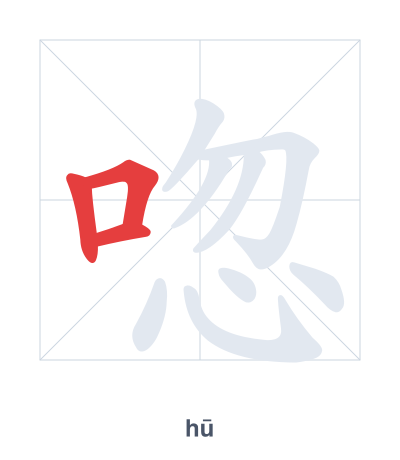
Stroke order practice for 唿 - hū

Practice Writing 唿 (hū)

Open Hanzi Writer to see the animated stroke order and practice writing 唿 with real-time feedback.

The character (hū) is written with 11 strokes. Follow the standard Chinese stroke order: top to bottom, left to right, outside before inside. The radical is one of its key components.

Practice the correct stroke order with the Hanzi Writer app to see animated stroke-by-stroke guidance with real-time feedback.

means whoosh (sound of wind or fire).

Character
Pinyinhū (hu)
Meaningwhoosh (sound of wind or fire)
Strokes11
Radical
Difficulty4.2/5

唿 is a phono-semantic compound: the radical 口 indicates a sound, while the phonetic component 忽 (hū, meaning 'sudden') provides the pronunciation. Together, they evoke the abrupt 'whoosh' sound of a gust of wind or burst of flame.

💡 Memory Tip: Imagine a mouth (口) suddenly blowing out a candle with a loud 'whoosh'—the right side 忽 looks like a flame flickering out.

hū shào
to whistle (with the mouth)
whoosh (sound of wind or fire)

他吹了一个唿哨。

tā chuī le yí gè hū shào

He whistled.

风唿地吹过。

fēng hū dì chuī guò

The wind blew past with a whoosh.

唿,火灭了。

hū huǒ miè le

Whoosh, the fire went out.

Character Pinyin Strokes Radical
(current) 11
cī / zī 9
9
è 9
Stroke order practice for 唿 - hū

Practice Writing 唿 (hū)

Open Hanzi Writer to see the animated stroke order and practice writing 唿 with real-time feedback.

✨ Animated stroke order · Handwriting recognition · HSK-graded practice · Free to use

Frequently Asked Questions about 唿

唿 is made of the radical 口 (mouth) on the left and 忽 (hū, meaning 'sudden' or 'neglect') on the right. The 口 indicates that this character represents a sound made by the mouth, while 忽 provides the pronunciation hū and hints at the sudden, quick nature of a whooshing sound like wind or fire.

Characters with Radical 口

Other 11-Stroke Characters