痼 (gù) means "chronic; deep-rooted" in Chinese. It has 13 strokes with the radical 疒.
Rated 4.2/5 in difficulty (advanced).
Appears in 3+ common words including 痼疾 (gù jí), 痼习 (gù xí), 沉痼 (chén gù).
Due to its 13 strokes, Hanzi Writer's error detection shows 痼 requires focused practice — most learners need 10+ attempts for consistent accuracy.
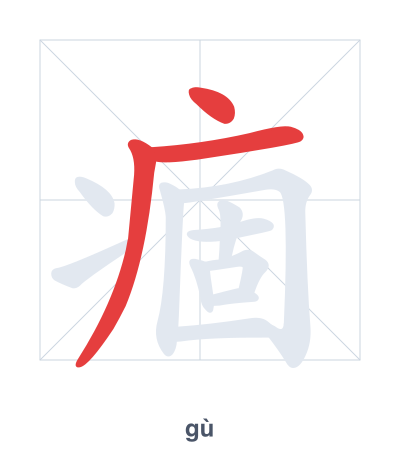
Open Hanzi Writer to see the animated stroke order and practice writing 痼 with real-time feedback.
The character 痼 (gù) is written with 13 strokes. Follow the standard Chinese stroke order: top to bottom, left to right, outside before inside. The radical 疒 is one of its key components.
Practice the correct stroke order with the Hanzi Writer app to see animated stroke-by-stroke guidance with real-time feedback.
痼 means chronic; deep-rooted.
This character combines the illness radical 疒 with 固 (gù, meaning 'solid' or 'fixed'), visually indicating a disease that has become firmly established. The left side represents sickness, while the right side conveys the idea of something stubbornly set, together forming the concept of a chronic or deep-rooted condition.
💡 Memory Tip: Imagine a patient in a hospital bed (疒) who is so stubborn that he is literally fixed (固) to the mattress, suffering from a chronic illness that won't go away.
他的痼疾又发作了。
tā de gù jí yòu fā zuò le
His chronic illness flared up again.
这种痼习很难改变。
zhè zhǒng gù xí hěn nán gǎi biàn
This chronic habit is hard to change.
他的病情已成沉痼。
tā de bìng qíng yǐ chéng chén gù
His condition has become chronic.
Open Hanzi Writer to see the animated stroke order and practice writing 痼 with real-time feedback.
✨ Animated stroke order · Handwriting recognition · HSK-graded practice · Free to use
The character 痼 consists of the radical 疒 (illness) on the left and 固 (firm, solid) on the right. This combination suggests a disease or habit that is firmly rooted, matching the meaning 'chronic' or 'deep-rooted.'