构 (gòu) means "to construct; structure" in Chinese. It has 8 strokes with the radical 木, and is HSK Level 4.
Rated 3.7/5 in difficulty (challenging).
Harder than 46% of HSK Level 4 characters.
Appears in 3+ common words including 结构 (jié gòu), 机构 (jī gòu), 构成 (gòu chéng).
Due to its 8 strokes, Hanzi Writer's error detection shows 构 requires focused practice — most learners need 10+ attempts for consistent accuracy.
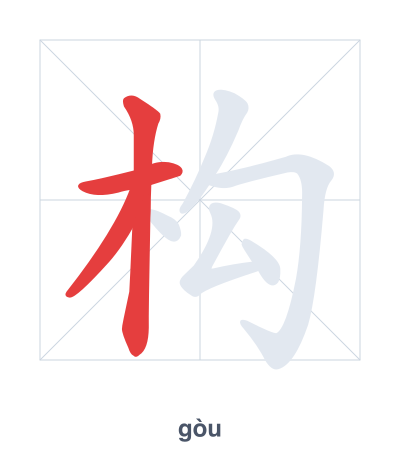
Open Hanzi Writer to see the animated stroke order and practice writing 构 with real-time feedback.
The character 构 (gòu) is written with 8 strokes. Follow the standard Chinese stroke order: top to bottom, left to right, outside before inside. The radical 木 is one of its key components.
Practice the correct stroke order with the Hanzi Writer app to see animated stroke-by-stroke guidance with real-time feedback.
构 means to construct; structure.
As an HSK Level 4 character, 构 is an intermediate-level character.
构 combines the radical 木 (wood/tree) with 冓 (gòu), an ancient pictograph of two crossed or joined timbers. Originally meaning 'to construct with wood,' the component 冓 visually represents two pieces of wood interlocking, which together with 木 emphasizes building a wooden framework or structure.
💡 Memory Tip: Picture a tree (木) with two crossed logs (冓) leaning against it, showing you how to construct a simple shelter.
句子结构简单。
jù zi jié gòu jiǎn dān
The sentence structure is simple.
这是一所机构。
zhè shì yī suǒ jī gòu
This is an institution.
这由三部分构成。
zhè yóu sān bù fèn gòu chéng
This consists of three parts.
Open Hanzi Writer to see the animated stroke order and practice writing 构 with real-time feedback.
✨ Animated stroke order · Handwriting recognition · HSK-graded practice · Free to use
构 is made of the radical 木 (wood/tree) on the left and the phonetic component 勾 (gōu, hook) on the right. The wood radical hints at physical construction using materials like timber, while the right side gives the pronunciation gòu and suggests the idea of 'hooking' or 'joining' pieces together to form a structure.