诰 (gào) means "imperial edict" in Chinese. It has 9 strokes with the radical 讠.
Rated 3.7/5 in difficulty (challenging).
Appears in 3+ common words including 诰命 (gào mìng), 封诰 (fēng gào), 诰封 (gào fēng).
Due to its 9 strokes, Hanzi Writer's error detection shows 诰 requires focused practice — most learners need 10+ attempts for consistent accuracy.
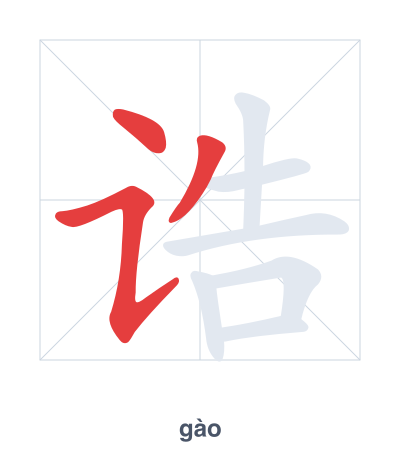
Open Hanzi Writer to see the animated stroke order and practice writing 诰 with real-time feedback.
The character 诰 (gào) is written with 9 strokes. Follow the standard Chinese stroke order: top to bottom, left to right, outside before inside. The radical 讠 is one of its key components.
Practice the correct stroke order with the Hanzi Writer app to see animated stroke-by-stroke guidance with real-time feedback.
诰 means imperial edict.
诰 is a compound character with the speech radical 讠 (words) and the phonetic component 告 (gào, meaning 'to tell or announce'). Since an imperial edict is a formal announcement from the emperor, the character visually combines 'words' with 'announce' to convey the idea of a royal decree.
💡 Memory Tip: Picture a herald standing on a platform (讠) shouting (告) the emperor's written edict to the crowd below.
皇帝颁布了诰命。
huáng dì bān bù le gào mìng
The Emperor issued an imperial mandate.
他得到了古代的封诰。
tā dé dào le gǔ dài de fēng gào
He received an ancient imperial title.
诰封是古代的一种荣誉。
gào fēng shì gǔ dài de yī zhǒng róng yù
Gaofeng was a type of honor in ancient times.
Open Hanzi Writer to see the animated stroke order and practice writing 诰 with real-time feedback.
✨ Animated stroke order · Handwriting recognition · HSK-graded practice · Free to use
诰 is made of the radical 讠 (speech) on the left and the phonetic component 告 (gào, to tell) on the right. The radical indicates the character relates to spoken or written language, while 告 hints at the pronunciation and the idea of announcing. Together they form the meaning of an official announcement or imperial edict.