溉 (gài) means "To irrigate; to wash." in Chinese. It has 12 strokes with the radical 氵, and is HSK Level 7.
Rated 4.2/5 in difficulty (advanced).
Harder than 68% of HSK Level 7 characters.
Appears in 3+ common words including 灌溉 (guàn gài), 溉田 (gài tián), 溉灌 (gài guàn).
Due to its 12 strokes, Hanzi Writer's error detection shows 溉 requires focused practice — most learners need 10+ attempts for consistent accuracy.
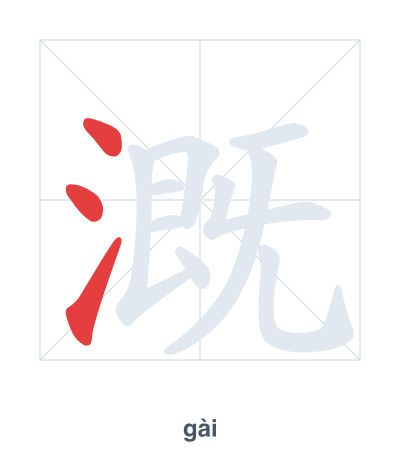
Open Hanzi Writer to see the animated stroke order and practice writing 溉 with real-time feedback.
The character 溉 (gài) is written with 12 strokes. Follow the standard Chinese stroke order: top to bottom, left to right, outside before inside. The radical 氵 is one of its key components.
Practice the correct stroke order with the Hanzi Writer app to see animated stroke-by-stroke guidance with real-time feedback.
溉 means To irrigate; to wash..
As an HSK Level 7 character, 溉 is an intermediate-level character.
溉 is a phono-semantic compound: the water radical 氵 indicates the meaning relates to water (irrigation, washing), and the right component 既 (jì, meaning 'already') provides the sound. In ancient agricultural contexts, irrigating channels brought water to fields, and the character visually shows water reaching its destination.
💡 Memory Tip: Imagine a farmer using a hose (氵) to water a field that already (既) has crops growing, washing them clean.
农民在灌溉农田。
nóng mín zài guàn gài nóng tián
Farmers are irrigating the farmland.
这些水用来溉田。
zhè xiē shuǐ yòng lái gài tián
This water is used to irrigate the fields.
这里的溉灌很方便。
zhè lǐ de gài guàn hěn fāng biàn
Irrigation here is very convenient.
Open Hanzi Writer to see the animated stroke order and practice writing 溉 with real-time feedback.
✨ Animated stroke order · Handwriting recognition · HSK-graded practice · Free to use
The character 溉 is composed of the water radical 氵 on the left and the phonetic component 既 on the right. The water radical directly links to its meanings of irrigating and washing, while 既 provides pronunciation cues. Together, they create a character associated with the movement or application of water.