爹 (diē) means "Dad; father (informal or dialectal)." in Chinese. It has 10 strokes with the radical 父, and is HSK Level 7.
Rated 4.2/5 in difficulty (advanced).
Harder than 71% of HSK Level 7 characters.
Appears in 3+ common words including 爹爹 (diē diē), 爹妈 (diē mā), 亲爹 (qīn diē).
Due to its 10 strokes, Hanzi Writer's error detection shows 爹 requires focused practice — most learners need 10+ attempts for consistent accuracy.
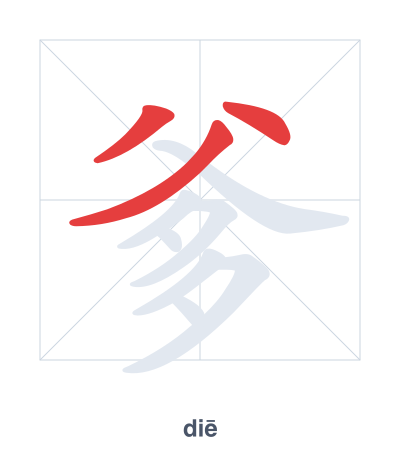
Open Hanzi Writer to see the animated stroke order and practice writing 爹 with real-time feedback.
The character 爹 (diē) is written with 10 strokes. Follow the standard Chinese stroke order: top to bottom, left to right, outside before inside. The radical 父 is one of its key components.
Practice the correct stroke order with the Hanzi Writer app to see animated stroke-by-stroke guidance with real-time feedback.
爹 means Dad; father (informal or dialectal)..
As an HSK Level 7 character, 爹 is an intermediate-level character.
爹 combines the radical 父 (father) with 多 (many), suggesting a father of many children. In ancient China, a large family was common, so this visual compound depicts a dad surrounded by multiple offspring.
💡 Memory Tip: Imagine a father (父) having so many kids (多) that his title became '爹'—the dad of a big crowd.
爹爹,您请坐。
diē diē nín qǐng zuò
Father, please have a seat.
爹妈对他很好。
diē mā duì tā hěn hǎo
His parents are very good to him.
他是我的亲爹。
tā shì wǒ de qīn diē
He is my biological father.
Open Hanzi Writer to see the animated stroke order and practice writing 爹 with real-time feedback.
✨ Animated stroke order · Handwriting recognition · HSK-graded practice · Free to use
The character 爹 combines 父 (father) on top and 多 (many) on the bottom. The top part gives the basic meaning of "father," while the bottom part may hint at a father who has many children. Together, they form the informal word for dad.