霏 (fēi) means "Falling (of snow or rain); misty" in Chinese. It has 16 strokes with the radical 雨.
Rated 4.2/5 in difficulty (advanced).
Appears in 3+ common words including 霏霏 (fēi fēi), 霏微 (fēi wēi), 烟霏 (yān fēi).
Due to its 16 strokes, Hanzi Writer's error detection shows 霏 requires focused practice — most learners need 10+ attempts for consistent accuracy.
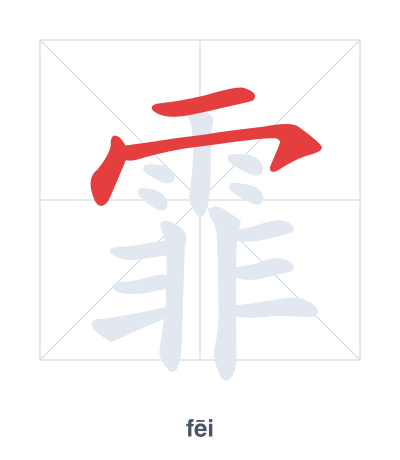
Open Hanzi Writer to see the animated stroke order and practice writing 霏 with real-time feedback.
The character 霏 (fēi) is written with 16 strokes. Follow the standard Chinese stroke order: top to bottom, left to right, outside before inside. The radical 雨 is one of its key components.
Practice the correct stroke order with the Hanzi Writer app to see animated stroke-by-stroke guidance with real-time feedback.
霏 means Falling (of snow or rain); misty.
霏 is a phono-semantic compound: the radical 雨 (rain) indicates weather-related meaning, while the phonetic component 非 (fēi) also suggests the scattering or fluttering motion of falling snow or mist, as seen in ancient texts describing rain or snow drifting down.
💡 Memory Tip: Picture rain (雨) falling like two fluttering wings (非) in a soft, misty snowfall.
雨雪霏霏。
yǔ xuě fēi fēi
The rain and snow are falling thick and fast.
晨雾霏微。
chén wù fēi wēi
The morning mist is light and drifting.
山间烟霏缭绕。
shān jiān yān fēi liáo rào
Mist and clouds linger in the mountains.
Open Hanzi Writer to see the animated stroke order and practice writing 霏 with real-time feedback.
✨ Animated stroke order · Handwriting recognition · HSK-graded practice · Free to use
霏 is composed of the radical 雨 (rain) on top and 非 (fēi) below. The rain radical gives the character its connection to weather phenomena, while 非 provides pronunciation. Together, they create the image of rain or snow falling in a thick, misty manner.