蠊 (lián) means "cockroach" in Chinese. It has 19 strokes with the radical 虫.
Rated 4.2/5 in difficulty (advanced).
Appears in 3+ common words including 蜚蠊 (fēi lián), 蠊虫 (lián chóng), 蜚蠊目 (fēi lián mù).
Due to its 19 strokes, Hanzi Writer's error detection shows 蠊 requires focused practice — most learners need 10+ attempts for consistent accuracy.
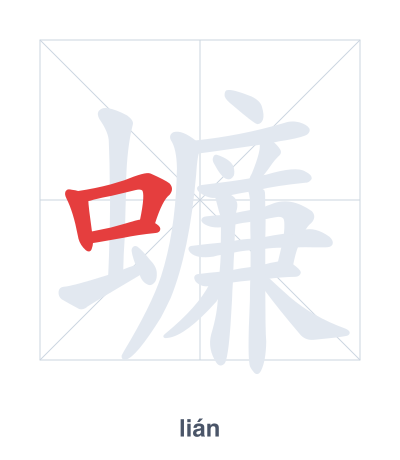
Open Hanzi Writer to see the animated stroke order and practice writing 蠊 with real-time feedback.
The character 蠊 (lián) is written with 19 strokes. Follow the standard Chinese stroke order: top to bottom, left to right, outside before inside. The radical 虫 is one of its key components.
Practice the correct stroke order with the Hanzi Writer app to see animated stroke-by-stroke guidance with real-time feedback.
蠊 means cockroach.
蠊 is a phono-semantic compound. The radical 虫 (insect) indicates it belongs to the insect category, while 廉 (lián) provides the pronunciation. Together they form the character for cockroach, a common insect.
💡 Memory Tip: Picture a cockroach (虫) that is so cheap (廉) it scuttles across your kitchen floor wearing a tiny price tag.
蜚蠊就是蟑螂。
fēi lián jiù shì zhāng láng
Blattaria are cockroaches.
厨房里有蠊虫。
chú fáng lǐ yǒu lián chóng
There are cockroaches in the kitchen.
蜚蠊目包含很多种。
fēi lián mù bāo hán hěn duō zhǒng
The order Blattodea includes many species.
Open Hanzi Writer to see the animated stroke order and practice writing 蠊 with real-time feedback.
✨ Animated stroke order · Handwriting recognition · HSK-graded practice · Free to use
蠊 is a phono-semantic compound. The left side 虫 (insect radical) indicates it is an insect, and the right side 廉 provides the pronunciation lián. Together, the character means "cockroach."