卖 (mài) means "to sell" in Chinese. It has 8 strokes with the radical 十, and is HSK Level 2.
Rated 2.9/5 in difficulty (moderate).
Harder than 35% of HSK Level 2 characters.
Appears in 3+ common words including 外卖 (wài mài), 买卖 (mǎi mài), 卖完 (mài wán).
Hanzi Writer's stroke validation shows learners typically need 5-8 attempts to write 卖 with correct proportion and order.
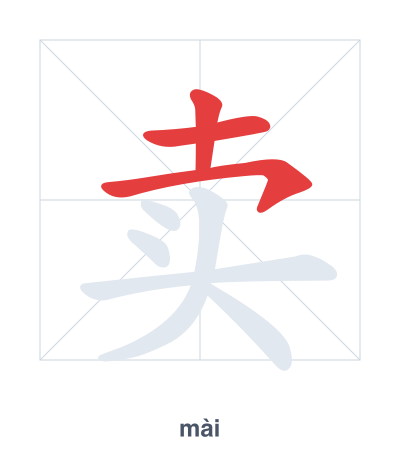
Open Hanzi Writer to see the animated stroke order and practice writing 卖 with real-time feedback.
The character 卖 (mài) is written with 8 strokes. Follow the standard Chinese stroke order: top to bottom, left to right, outside before inside. The radical 十 is one of its key components.
Practice the correct stroke order with the Hanzi Writer app to see animated stroke-by-stroke guidance with real-time feedback.
卖 means to sell.
As an HSK Level 2 character, 卖 is among the first characters beginners learn.
卖 is a simplified compound of 十 (ten) and 买 (to buy). In ancient commerce, selling was seen as the opposite of buying, with the 'ten' possibly representing a counter or transaction marker, so the character visually suggests exchanging goods for a number of units.
💡 Memory Tip: Picture a seller holding up ten items (十) and shouting 'Buy them!' (买) to sell them quickly.
我今天点外卖。
wǒ jīn tiān diǎn wài mài
I'm ordering takeout today.
这里的买卖很好。
zhè lǐ de mǎi mài hěn hǎo
Business here is very good.
苹果已经卖完了。
píng guǒ yǐ jīng mài wán le
The apples are sold out.
Open Hanzi Writer to see the animated stroke order and practice writing 卖 with real-time feedback.
✨ Animated stroke order · Handwriting recognition · HSK-graded practice · Free to use
The character 卖 is composed of the top radical 十 (ten) and the bottom component 买 (to buy). This structure suggests the idea of selling as the opposite of buying — you take something you bought and put a price (十) on it to sell. Essentially, selling involves exchanging goods for money, turning a purchase into a sale.