簖 (duàn) means "bamboo fish trap" in Chinese. It has 17 strokes with the radical 竹.
Rated 4.2/5 in difficulty (advanced).
Appears in 3+ common words including 蟹簖 (xiè duàn), 鱼簖 (yú duàn), 簖口 (duàn kǒu).
Due to its 17 strokes, Hanzi Writer's error detection shows 簖 requires focused practice — most learners need 10+ attempts for consistent accuracy.
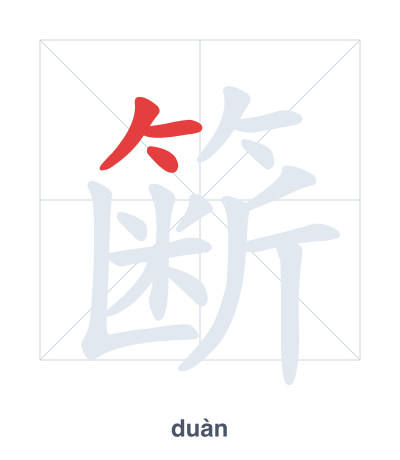
Open Hanzi Writer to see the animated stroke order and practice writing 簖 with real-time feedback.
The character 簖 (duàn) is written with 17 strokes. Follow the standard Chinese stroke order: top to bottom, left to right, outside before inside. The radical 竹 is one of its key components.
Practice the correct stroke order with the Hanzi Writer app to see animated stroke-by-stroke guidance with real-time feedback.
簖 means bamboo fish trap.
This compound character combines the radical 竹 (bamboo, the material) with 断 (duàn, meaning 'to break' or 'to sever'), which also provides the sound. A bamboo fish trap is typically made by cutting and weaving bamboo strips into a funnel-shaped enclosure that blocks fish from escaping.
💡 Memory Tip: Imagine a bamboo (竹) trap that 'breaks' (断) the fish's path, trapping them inside.
湖里放了很多蟹簖。
hú lǐ fàng le hěn duō xiè duàn
Many crab traps were placed in the lake.
鱼儿跳过了鱼簖。
yú ér tiào guò le yú duàn
The fish jumped over the bamboo fish trap.
簖口处有很多小鱼。
duàn kǒu chù yǒu hěn duō xiǎo yú
There are many small fish at the opening of the trap.
Open Hanzi Writer to see the animated stroke order and practice writing 簖 with real-time feedback.
✨ Animated stroke order · Handwriting recognition · HSK-graded practice · Free to use
簖 is made of the radical 竹 (bamboo) on top and the phonetic component 断 (to break, to cut) below. The combination suggests a bamboo device that 'breaks' or intercepts fish, which is exactly what a fish trap does—it blocks fish so they cannot escape.