栋 (dòng) means "ridgepole; pillar; classifier for buildings" in Chinese. It has 9 strokes with the radical 木, and is HSK Level 7.
Rated 4/5 in difficulty (challenging).
Harder than 42% of HSK Level 7 characters.
Appears in 3+ common words including 一栋楼 (yī dòng lóu), 几栋 (jǐ dòng), 栋梁 (dòng liáng).
Due to its 9 strokes, Hanzi Writer's error detection shows 栋 requires focused practice — most learners need 10+ attempts for consistent accuracy.
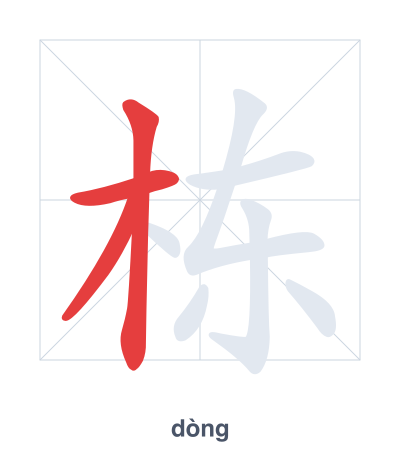
Open Hanzi Writer to see the animated stroke order and practice writing 栋 with real-time feedback.
The character 栋 (dòng) is written with 9 strokes. Follow the standard Chinese stroke order: top to bottom, left to right, outside before inside. The radical 木 is one of its key components.
Practice the correct stroke order with the Hanzi Writer app to see animated stroke-by-stroke guidance with real-time feedback.
栋 means ridgepole; pillar; classifier for buildings.
As an HSK Level 7 character, 栋 is an intermediate-level character.
栋 combines the radical 木 (wood) with the phonetic component 东 (dōng, east), indicating a wooden ridgepole—the main horizontal beam in a roof. In ancient Chinese architecture, the ridgepole was often oriented east–west, aligning with the sun’s path. This character also serves as a classifier for buildings, reflecting its role as a structural core.
💡 Memory Tip: Imagine a wooden beam (木) stretching eastward (东) across the top of a house, holding up the whole roof as the ridgepole.
我住在那一栋楼。
wǒ zhù zài nà yī dòng lóu
I live in that building.
这里有几栋新房子。
zhè lǐ yǒu jǐ dòng xīn fáng zi
There are several new houses here.
他是国家的栋梁。
tā shì guó jiā de dòng liáng
He is a pillar of the state.
Open Hanzi Writer to see the animated stroke order and practice writing 栋 with real-time feedback.
✨ Animated stroke order · Handwriting recognition · HSK-graded practice · Free to use
栋 has the radical 木 (wood) on the left, which connects to wooden building materials, and 东 (dōng, east) on the right gives the sound. Together they form a phono-semantic compound where 木 suggests the meaning of ridgepole or pillar, and 东 indicates the pronunciation dòng.