懂 (dǒng) means "to understand" in Chinese. It has 15 strokes with the radical 忄, and is HSK Level 2.
Rated 3.7/5 in difficulty (challenging).
Harder than 75% of HSK Level 2 characters.
Appears in 3+ common words including 懂事 (dǒng shì), 听懂 (tīng dǒng), 懂得 (dǒng de).
Due to its 15 strokes, Hanzi Writer's error detection shows 懂 requires focused practice — most learners need 10+ attempts for consistent accuracy.
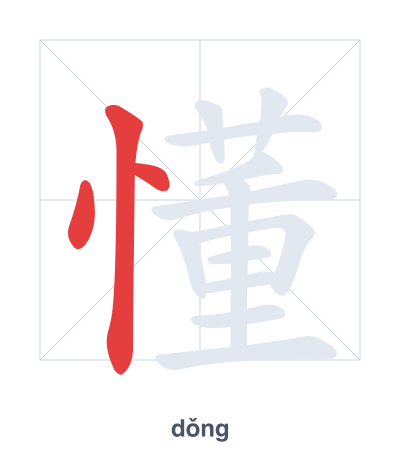
Open Hanzi Writer to see the animated stroke order and practice writing 懂 with real-time feedback.
The character 懂 (dǒng) is written with 15 strokes. Follow the standard Chinese stroke order: top to bottom, left to right, outside before inside. The radical 忄 is one of its key components.
Practice the correct stroke order with the Hanzi Writer app to see animated stroke-by-stroke guidance with real-time feedback.
懂 means to understand.
As an HSK Level 2 character, 懂 is among the first characters beginners learn.
懂 is a phono-semantic compound: the left radical 忄 (heart/mind) indicates that understanding is an internal process, while the right side 董 (dǒng) provides the pronunciation and suggests the idea of 'managing' or 'overseeing'—to understand is to mentally grasp and organize information.
💡 Memory Tip: Imagine a heart (忄) holding a heavy (重) bundle of grass (艹) — to 'understand' is to carry that weight with wisdom in your heart.
这个孩子很懂事。
zhè ge hái zi hěn dǒng shì
This child is very sensible and mature.
你听懂了吗?
nǐ tīng dǒng le ma
Did you understand?
我懂得这个道理。
wǒ dǒng de zhè ge dào lǐ
I understand this principle.
Open Hanzi Writer to see the animated stroke order and practice writing 懂 with real-time feedback.
✨ Animated stroke order · Handwriting recognition · HSK-graded practice · Free to use
懂 is made of the heart radical 忄 on the left and the phonetic component 董 on the right. The heart radical connects the character to feelings or mental processes, which fits its meaning 'to understand' as understanding involves the mind and heart.