咚 (dōng) means "thud; thump (onomatopoeia)" in Chinese. It has 8 strokes with the radical 口.
Rated 3.7/5 in difficulty (challenging).
Appears in 3+ common words including 咚咚 (dōng dōng), 叮咚 (dīng dōng), 咚的一声 (dōng de yī shēng).
Due to its 8 strokes, Hanzi Writer's error detection shows 咚 requires focused practice — most learners need 10+ attempts for consistent accuracy.
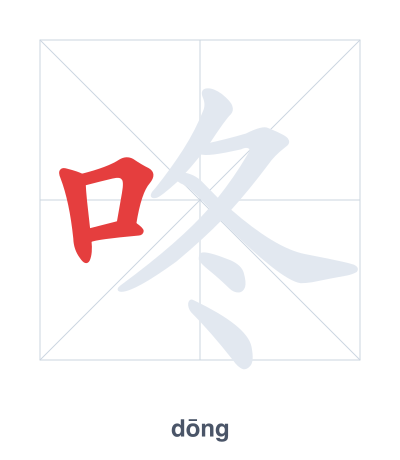
Open Hanzi Writer to see the animated stroke order and practice writing 咚 with real-time feedback.
The character 咚 (dōng) is written with 8 strokes. Follow the standard Chinese stroke order: top to bottom, left to right, outside before inside. The radical 口 is one of its key components.
Practice the correct stroke order with the Hanzi Writer app to see animated stroke-by-stroke guidance with real-time feedback.
咚 means thud; thump (onomatopoeia).
咚 is a compound character combining the mouth radical 口 (indicating sound or speech) with 冬 (dōng, 'winter') as a phonetic component. Since it is an onomatopoeia, the mouth radical directly represents the act of making the 'dong' sound, such as a heavy thud or thump.
💡 Memory Tip: Imagine a frozen block of ice (冬) falling from a rooftop and hitting the ground with a loud 'DONG!' as a mouth (口) opens wide in surprise.
门外咚咚响。
mén wài dōng dōng xiǎng
There is a thumping sound outside the door.
门铃叮咚响。
mén líng dīng dōng xiǎng
The doorbell is chiming.
咚的一声,球落水了。
dōng de yī shēng qiú luò shuǐ le
With a splash, the ball fell into the water.
Open Hanzi Writer to see the animated stroke order and practice writing 咚 with real-time feedback.
✨ Animated stroke order · Handwriting recognition · HSK-graded practice · Free to use
咚 combines the radical 口 (mouth) on the left with 冬 (dōng, winter) on the right. The mouth radical indicates it is a sound-related word, while 冬 provides the pronunciation. Together, 咚 represents onomatopoeia for a thud or thump sound.