迭 (dié) means "Repeatedly; again and again" in Chinese. It has 8 strokes with the radical 辶, and is HSK Level 7.
Rated 3.7/5 in difficulty (challenging).
Harder than 32% of HSK Level 7 characters.
Appears in 3+ common words including 迭起 (dié qǐ), 更迭 (gēng dié), 忙不迭 (máng bù dié).
Due to its 8 strokes, Hanzi Writer's error detection shows 迭 requires focused practice — most learners need 10+ attempts for consistent accuracy.
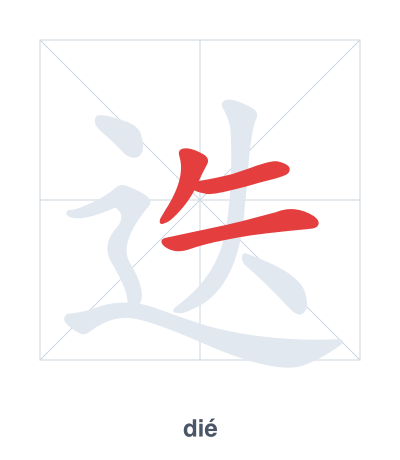
Open Hanzi Writer to see the animated stroke order and practice writing 迭 with real-time feedback.
The character 迭 (dié) is written with 8 strokes. Follow the standard Chinese stroke order: top to bottom, left to right, outside before inside. The radical 辶 is one of its key components.
Practice the correct stroke order with the Hanzi Writer app to see animated stroke-by-stroke guidance with real-time feedback.
迭 means Repeatedly; again and again.
As an HSK Level 7 character, 迭 is an intermediate-level character.
The character 迭 combines the radical 辶 (walking) with the phonetic component 失 (shī). Its original meaning was 'to alternate' or 'to take turns', implying repeated sequential movement. The walking radical suggests motion happening in cycles, leading to the sense of 'again and again'.
💡 Memory Tip: Picture a person walking (辶) and repeatedly losing (失) their keys, having to retrace the same steps over and over.
比赛高潮迭起。
bǐ sài gāo cháo dié qǐ
The match was full of highlights.
四季不断更迭。
sì jì bù duàn gēng dié
The four seasons change continuously.
他忙不迭地跑了。
tā máng bù dié dì pǎo le
He ran away in a great hurry.
Open Hanzi Writer to see the animated stroke order and practice writing 迭 with real-time feedback.
✨ Animated stroke order · Handwriting recognition · HSK-graded practice · Free to use
The character 迭 consists of the radical 辶 (walk) on the left and 失 (shī, to lose) on the right. The radical 辶 suggests movement or change over time, while 失 provides the pronunciation 'dié'. Together they convey the idea of things happening repeatedly, like losing something over and over.