雉 (zhì) means "pheasant" in Chinese. It has 13 strokes with the radical 隹.
Rated 4.2/5 in difficulty (advanced).
Appears in 3+ common words including 雉鸡 (zhì jī), 野雉 (yě zhì), 雉堞 (zhì dié).
Due to its 13 strokes, Hanzi Writer's error detection shows 雉 requires focused practice — most learners need 10+ attempts for consistent accuracy.
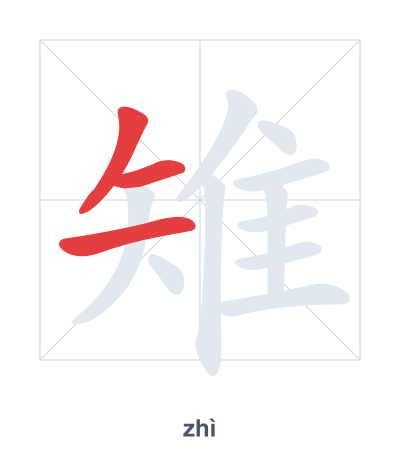
Open Hanzi Writer to see the animated stroke order and practice writing 雉 with real-time feedback.
The character 雉 (zhì) is written with 13 strokes. Follow the standard Chinese stroke order: top to bottom, left to right, outside before inside. The radical 隹 is one of its key components.
Practice the correct stroke order with the Hanzi Writer app to see animated stroke-by-stroke guidance with real-time feedback.
雉 means pheasant.
| Character | 雉 |
| Pinyin | zhì (zhi) |
| Meaning | pheasant |
| Strokes | 13 |
| Radical | 隹 |
| Difficulty | 4.2/5 |
The character 雉 combines 矢 (arrow) on the left with the bird radical 隹 on the right, originally depicting a bird struck by an arrow—a pheasant, a common game bird hunted with arrows.
💡 Memory Tip: Imagine a pheasant proudly strutting with an arrow (矢) stuck in its tailfeathers (隹) as a hunter's trophy.
山上有几只雉鸡。
shān shàng yǒu jǐ zhī zhì jī
There are a few pheasants on the mountain.
野雉在草丛里。
yě zhì zài cǎo cóng lǐ
The wild pheasant is in the bushes.
城墙上有雉堞。
chéng qiáng shàng yǒu zhì dié
There are battlements on the city wall.
Open Hanzi Writer to see the animated stroke order and practice writing 雉 with real-time feedback.
✨ Animated stroke order · Handwriting recognition · HSK-graded practice · Free to use
雉 is composed of 矢 (arrow) on the left and 隹 (short-tailed bird) on the right. The arrow component suggests hunting, and the bird component indicates that a pheasant is a type of bird that was often hunted with arrows.