嗲 (diē) means "Coquettish; sweet and charming." in Chinese. It has 13 strokes with the radical 口.
Rated 4.2/5 in difficulty (advanced).
Appears in 3+ common words including 嗲 (diē), 撒嗲 (sā diē), 嗲声嗲气 (diē shēng diē qì).
Due to its 13 strokes, Hanzi Writer's error detection shows 嗲 requires focused practice — most learners need 10+ attempts for consistent accuracy.
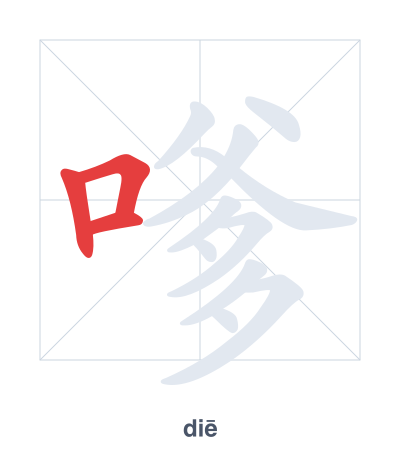
Open Hanzi Writer to see the animated stroke order and practice writing 嗲 with real-time feedback.
The character 嗲 (diē) is written with 13 strokes. Follow the standard Chinese stroke order: top to bottom, left to right, outside before inside. The radical 口 is one of its key components.
Practice the correct stroke order with the Hanzi Writer app to see animated stroke-by-stroke guidance with real-time feedback.
嗲 means Coquettish; sweet and charming..
嗲 is a phono-semantic compound where 口 (mouth) represents speech or sound, and 爹 (father) provides the pronunciation diē. The character evokes the sweet, coquettish tone of a child or young woman speaking endearingly to her father.
💡 Memory Tip: Picture a little girl using her mouth (口) to call her father (爹) in a sugary, pleading voice: 'Daddy~' — that's the coquettish sound of 嗲.
她说话的声音很嗲。
tā shuō huà de shēng yīn hěn diē
Her voice is very sweet and coquettish.
妹妹总爱跟妈妈撒嗲。
mèi mèi zǒng ài gēn mā mā sā diē
My younger sister always loves acting cute and coquettish with mom.
她说话总是嗲声嗲气的。
tā shuō huà zǒng shì diē shēng diē qì de
She always speaks in a sweet, coquettish voice.
Open Hanzi Writer to see the animated stroke order and practice writing 嗲 with real-time feedback.
✨ Animated stroke order · Handwriting recognition · HSK-graded practice · Free to use
嗲 is made of the radical 口 (mouth) on the left and 爹 (father) on the right. The mouth suggests speaking or making sounds, while 爹 hints at a childish, sweet way of talking to a father or an older person. Together, they create the idea of speaking in a coquettish, spoiled manner.