Hanzi Writer

How to Write 踮 (diǎn) — Meaning “to stand on tiptoe”

diǎn 15 strokes Radical: 足

踮 (diǎn) means "to stand on tiptoe" in Chinese. It has 15 strokes with the radical 足.

Rated 4.2/5 in difficulty (advanced).

Appears in 3+ common words including 踮脚 (diǎn jiǎo), 踮起 (diǎn qǐ), 踮着 (diǎn zhe).

Due to its 15 strokes, Hanzi Writer's error detection shows 踮 requires focused practice — most learners need 10+ attempts for consistent accuracy.
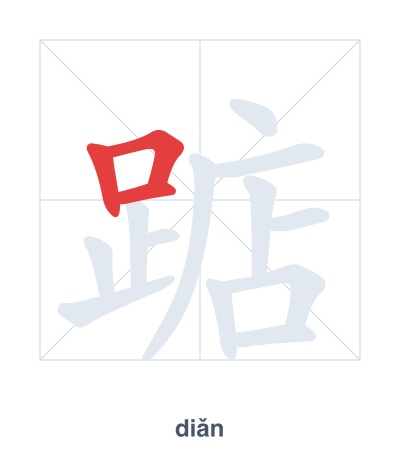
Stroke order practice for 踮 - diǎn

Practice Writing 踮 (diǎn)

Open Hanzi Writer to see the animated stroke order and practice writing 踮 with real-time feedback.

The character (diǎn) is written with 15 strokes. Follow the standard Chinese stroke order: top to bottom, left to right, outside before inside. The radical is one of its key components.

Practice the correct stroke order with the Hanzi Writer app to see animated stroke-by-stroke guidance with real-time feedback.

means to stand on tiptoe.

Character
Pinyindiǎn (dian)
Meaningto stand on tiptoe
Strokes15
Radical
Difficulty4.2/5

踮 is a phono-semantic compound. The left radical 足 (foot) indicates the meaning relates to a foot movement, while the right component 店 (shop) hints at the pronunciation diǎn. Together, they convey the action of standing on tiptoe, often to reach something high as if in a shop.

💡 Memory Tip: Picture your foot (足) pressing down on a shop (店) counter as you stretch up on tiptoe to grab a jar from a high shelf.

diǎn jiǎo
to stand on tiptoe
diǎn qǐ
to lift up (heels) to stand on tiptoe
diǎn zhe
standing on tiptoe

她踮脚看窗外。

tā diǎn jiǎo kàn chuāng wài

She stood on tiptoe to look out the window.

踮起脚尖跳舞。

diǎn qǐ jiǎo jiān tiào wǔ

Dancing on tiptoe.

他踮着脚走路。

tā diǎn zhe jiǎo zǒu lù

He walked on tiptoe.

Character Pinyin Strokes Radical
(current) diǎn 15
tāng 15
gēn 13
xiǎn 13
Stroke order practice for 踮 - diǎn

Practice Writing 踮 (diǎn)

Open Hanzi Writer to see the animated stroke order and practice writing 踮 with real-time feedback.

✨ Animated stroke order · Handwriting recognition · HSK-graded practice · Free to use

Frequently Asked Questions about 踮

The character 踮 has the radical 足 (foot) on the left and 店 (store) on the right. The radical hints that the action involves the foot, while 店 provides the pronunciation diǎn. Together, they create the idea of using your feet to stand on tiptoe, like stretching upward.

Characters with Radical 足

Other 15-Stroke Characters