谛 (dì) means "truth; to examine closely" in Chinese. It has 11 strokes with the radical 讠.
Rated 3.9/5 in difficulty (challenging).
Appears in 3+ common words including 真谛 (zhēn dì), 谛听 (dì tīng), 妙谛 (miào dì).
Due to its 11 strokes, Hanzi Writer's error detection shows 谛 requires focused practice — most learners need 10+ attempts for consistent accuracy.
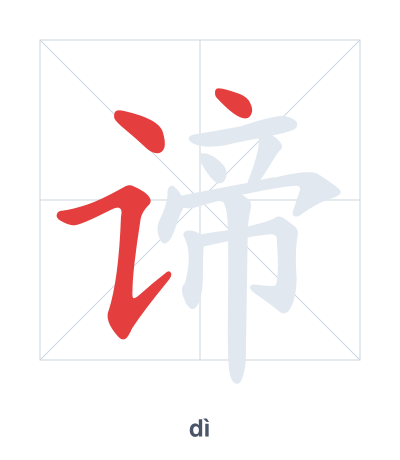
Open Hanzi Writer to see the animated stroke order and practice writing 谛 with real-time feedback.
The character 谛 (dì) is written with 11 strokes. Follow the standard Chinese stroke order: top to bottom, left to right, outside before inside. The radical 讠 is one of its key components.
Practice the correct stroke order with the Hanzi Writer app to see animated stroke-by-stroke guidance with real-time feedback.
谛 means truth; to examine closely.
This compound joins speech (讠) with emperor (帝), as imperial words were considered absolute truth. It originally meant to examine closely or perceive the true essence, linking careful scrutiny to the authority of divine or royal pronouncements.
💡 Memory Tip: Picture an emperor (帝) leaning in to speak (讠) a secret truth, and you must examine his every word closely.
领悟人生真谛。
lǐng wù rén shēng zhēn dì
To realize the true meaning of life.
他在屏息谛听。
tā zài bǐng xī dì tīng
He is listening intently with bated breath.
这其中有妙谛。
zhè qí zhōng yǒu miào dì
There is a profound truth within this.
Open Hanzi Writer to see the animated stroke order and practice writing 谛 with real-time feedback.
✨ Animated stroke order · Handwriting recognition · HSK-graded practice · Free to use
The left side is the radical 讠(speech), and the right side is 帝, which means emperor or divine authority. Together, they suggest a form of authoritative or careful speech that seeks the truth, linking to meanings like 'truth' and 'to examine closely'.