稻 (dào) means "rice; paddy" in Chinese. It has 15 strokes with the radical 禾, and is HSK Level 7.
Rated 4.2/5 in difficulty (advanced).
Harder than 77% of HSK Level 7 characters.
Appears in 3+ common words including 水稻 (shuǐ dào), 稻米 (dào mǐ), 稻草 (dào cǎo).
Due to its 15 strokes, Hanzi Writer's error detection shows 稻 requires focused practice — most learners need 10+ attempts for consistent accuracy.
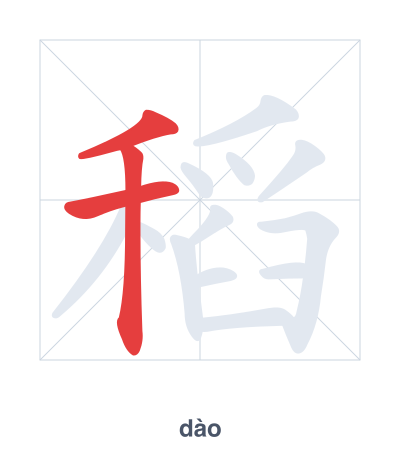
Open Hanzi Writer to see the animated stroke order and practice writing 稻 with real-time feedback.
The character 稻 (dào) is written with 15 strokes. Follow the standard Chinese stroke order: top to bottom, left to right, outside before inside. The radical 禾 is one of its key components.
Practice the correct stroke order with the Hanzi Writer app to see animated stroke-by-stroke guidance with real-time feedback.
稻 means rice; paddy.
As an HSK Level 7 character, 稻 is an intermediate-level character.
稻 is a compound character with the radical 禾 (grain) on the left, indicating it relates to rice or cereal crops. The right side 舀 (yǎo) originally depicted a hand dipping into a mortar, serving as a phonetic component and suggesting the action of scooping or processing rice grains. Together, the character visually represents a grain plant that is harvested and processed by scooping out the edible seeds.
💡 Memory Tip: Picture a hand (爫) scooping rice from a stone mortar (臼), with tall stalks of grain (禾) growing nearby in a flooded paddy field.
农民在种水稻。
nóng mín zài zhǒng shuǐ dào
Farmers are planting paddy rice.
这种稻米很好吃。
zhè zhòng dào mǐ hěn hǎo chī
This type of rice is very delicious.
地上有许多稻草。
dì shàng yǒu xǔ duō dào cǎo
There is a lot of straw on the ground.
Open Hanzi Writer to see the animated stroke order and practice writing 稻 with real-time feedback.
✨ Animated stroke order · Handwriting recognition · HSK-graded practice · Free to use
稻 combines the radical 禾 (grain) on the left and the phonetic component 舀 (yǎo, to ladle) on the right. The 禾 radical gives the meaning of grain or rice plant, while 舀 provides pronunciation. Together, they represent the rice plant, especially as it grows in paddies.