箪 (dān) means "round bamboo basket for food" in Chinese. It has 14 strokes with the radical 竹.
Rated 4.2/5 in difficulty (advanced).
Appears in 3+ common words including 箪食 (dān shí), 箪瓢 (dān piáo), 竹箪 (zhú dān).
Due to its 14 strokes, Hanzi Writer's error detection shows 箪 requires focused practice — most learners need 10+ attempts for consistent accuracy.
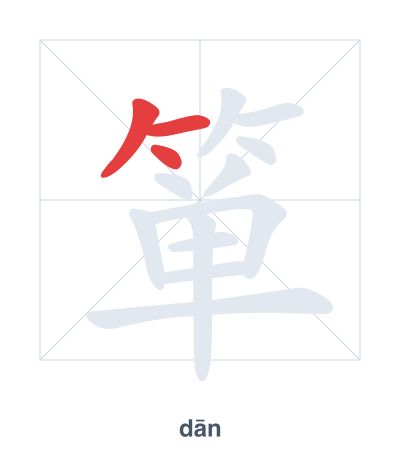
Open Hanzi Writer to see the animated stroke order and practice writing 箪 with real-time feedback.
The character 箪 (dān) is written with 14 strokes. Follow the standard Chinese stroke order: top to bottom, left to right, outside before inside. The radical 竹 is one of its key components.
Practice the correct stroke order with the Hanzi Writer app to see animated stroke-by-stroke guidance with real-time feedback.
箪 means round bamboo basket for food.
箪 is a compound character with the radical 竹 (bamboo) indicating it is made of bamboo, and the component 单 (dān) serving as a phonetic hint for pronunciation. The character depicts a round bamboo basket used for holding food, common in ancient Chinese households.
💡 Memory Tip: Imagine a single (单) bamboo (竹) basket that is perfectly round, like a bowl for your daily meal.
他过着箪食瓢饮的生活。
tā guò zhe dān sì piáo yǐn de shēng huó
He lives a simple and frugal life.
箪瓢虽小,也能盛饭。
dān piáo suī xiǎo yě néng chéng fàn
Although the bamboo basket and ladle are small, they can still hold food.
这是一个古老的竹箪。
zhè shì yí gè gǔ lǎo de zhú dān
This is an ancient bamboo food basket.
Open Hanzi Writer to see the animated stroke order and practice writing 箪 with real-time feedback.
✨ Animated stroke order · Handwriting recognition · HSK-graded practice · Free to use
The character 箪 consists of the bamboo radical ⺮ on top and 單 (dān, meaning 'single') below. The bamboo radical shows that the basket is made of bamboo, while 單 hints at its simple, single-compartment design for holding food.