猝 (cù) means "sudden; abrupt" in Chinese. It has 11 strokes with the radical 犭.
Rated 4.2/5 in difficulty (advanced).
Appears in 3+ common words including 猝死 (cù sǐ), 猝不及防 (cù bù jí fáng), 猝然 (cù rán).
Due to its 11 strokes, Hanzi Writer's error detection shows 猝 requires focused practice — most learners need 10+ attempts for consistent accuracy.
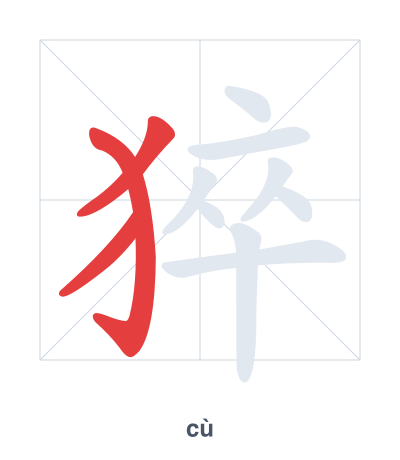
Open Hanzi Writer to see the animated stroke order and practice writing 猝 with real-time feedback.
The character 猝 (cù) is written with 11 strokes. Follow the standard Chinese stroke order: top to bottom, left to right, outside before inside. The radical 犭 is one of its key components.
Practice the correct stroke order with the Hanzi Writer app to see animated stroke-by-stroke guidance with real-time feedback.
猝 means sudden; abrupt.
The character 猝 combines the radical 犭 (dog) with 卒 (soldier, serving as phonetic). It originally evoked the image of a dog suddenly lunging or attacking, conveying the idea of abrupt, unexpected action.
💡 Memory Tip: Picture a dog (犭) lunging without warning at a soldier (卒) for a sudden, startling attack.
他因为过度劳累猝死了。
tā yīn wèi guò dù láo lèi cù sǐ le
He died suddenly from overwork.
这个变化让人猝不及防。
zhè ge biàn huà ràng rén cù bù jí fáng
This change caught people off guard.
事情猝然发生了。
shì qíng cù rán fā shēng le
The matter happened suddenly.
Open Hanzi Writer to see the animated stroke order and practice writing 猝 with real-time feedback.
✨ Animated stroke order · Handwriting recognition · HSK-graded practice · Free to use
The character 猝 combines the radical 犭 (dog) on the left and 卒 (zú, soldier or death) on the right. The dog radical hints at animal-like swiftness, while 卒 adds the idea of suddenness or death, creating the meaning 'sudden' or 'abrupt'.